32. Therefore when Mary came to where Jesus was, and saw him, she fell down at his feet, saying to him, “Lord, if you would have been here, my brother wouldn’t have died.”
God may sometimes seem silent in our lives, but within that silence lies deep love and purpose. Through the story of Lazarus's death in John 11, we learn that Jesus prepares the best miracles for those He loves. The resurrection of Lazarus is not just a miracle; it demonstrates God's power to overcome the authority of death and give new life. Even in our pain and despair, we must believe that God has love and plans for us, and we should wait for His will.
Every Monday morning: this week's sermon and 6-day devotional. Free, unsubscribe anytime.
Unsubscribe anytime from the link in each email. Already subscribed? Open the link in your email.
- John 11:32 32. Therefore when Mary came to where Jesus was, and saw him, she fell down at his feet, saying to him, “Lord, if you would have been here, my brother wouldn’t have died.”
- John 11 1. Now a certain man was sick, Lazarus from Bethany, of the village of Mary and her sister, Martha. 2. It was that Mary who had anointed the Lord with ointment, and wiped his feet with her hair, whose brother, Lazarus, was sick. 3. The sisters therefore sent to him, saying, “Lord, behold, he for whom you have great affection is sick.” 4. But when Jesus heard it, he said, “This sickness is not to death, but for the glory of God, that God’s Son may be glorified by it.” 5. Now Jesus loved Martha, and her sister, and Lazarus. 6. When therefore he heard that he was sick, he stayed two days in the place where he was. 7. Then after this he said to the disciples, “Let’s go into Judea again.” 8. The disciples told him, “Rabbi, the Jews were just trying to stone you, and are you going there again?” 9. Jesus answered, “Aren’t there twelve hours of daylight? If a man walks in the day, he doesn’t stumble, because he sees the light of this world. 10. But if a man walks in the night, he stumbles, because the light isn’t in him.” 11. He said these things, and after that, he said to them, “Our friend, Lazarus, has fallen asleep, but I am going so that I may awake him out of sleep.” 12. The disciples therefore said, “Lord, if he has fallen asleep, he will recover.” 13. Now Jesus had spoken of his death, but they thought that he spoke of taking rest in sleep. 14. So Jesus said to them plainly then, “Lazarus is dead. 15. I am glad for your sakes that I was not there, so that you may believe. Nevertheless, let’s go to him.” 16. Thomas therefore, who is called Didymus, said to his fellow disciples, “Let’s go also, that we may die with him.” 17. So when Jesus came, he found that he had been in the tomb four days already. 18. Now Bethany was near Jerusalem, about fifteen stadia away. 19. Many of the Jews had joined the women around Martha and Mary, to console them concerning their brother. 20. Then when Martha heard that Jesus was coming, she went and met him, but Mary stayed in the house. 21. Therefore Martha said to Jesus, “Lord, if you would have been here, my brother wouldn’t have died. 22. Even now I know that, whatever you ask of God, God will give you.” 23. Jesus said to her, “Your brother will rise again.” 24. Martha said to him, “I know that he will rise again in the resurrection at the last day.” 25. Jesus said to her, “I am the resurrection and the life. He who believes in me will still live, even if he dies. 26. Whoever lives and believes in me will never die. Do you believe this?” 27. She said to him, “Yes, Lord. I have come to believe that you are the Christ, God’s Son, he who comes into the world.” 28. When she had said this, she went away, and called Mary, her sister, secretly, saying, “The Teacher is here, and is calling you.” 29. When she heard this, she arose quickly, and went to him. 30. Now Jesus had not yet come into the village, but was in the place where Martha met him. 31. Then the Jews who were with her in the house, and were consoling her, when they saw Mary, that she rose up quickly and went out, followed her, saying, “She is going to the tomb to weep there.” 32. Therefore when Mary came to where Jesus was, and saw him, she fell down at his feet, saying to him, “Lord, if you would have been here, my brother wouldn’t have died.” 33. When Jesus therefore saw her weeping, and the Jews weeping who came with her, he groaned in the spirit, and was troubled, 34. and said, “Where have you laid him?” They told him, “Lord, come and see.” 35. Jesus wept. 36. The Jews therefore said, “See how much affection he had for him!” 37. Some of them said, “Couldn’t this man, who opened the eyes of him who was blind, have also kept this man from dying?” 38. Jesus therefore, again groaning in himself, came to the tomb. Now it was a cave, and a stone lay against it. 39. Jesus said, “Take away the stone.” Martha, the sister of him who was dead, said to him, “Lord, by this time there is a stench, for he has been dead four days.” 40. Jesus said to her, “Didn’t I tell you that if you believed, you would see God’s glory?” 41. So they took away the stone from the place where the dead man was lying. Jesus lifted up his eyes, and said, “Father, I thank you that you listened to me. 42. I know that you always listen to me, but because of the multitude that stands around I said this, that they may believe that you sent me.” 43. When he had said this, he cried with a loud voice, “Lazarus, come out!” 44. He who was dead came out, bound hand and foot with wrappings, and his face was wrapped around with a cloth. Jesus said to them, “Free him, and let him go.” 45. Therefore many of the Jews, who came to Mary and saw what Jesus did, believed in him. 46. But some of them went away to the Pharisees, and told them the things which Jesus had done. 47. The chief priests therefore and the Pharisees gathered a council, and said, “What are we doing? For this man does many signs. 48. If we leave him alone like this, everyone will believe in him, and the Romans will come and take away both our place and our nation.” 49. But a certain one of them, Caiaphas, being high priest that year, said to them, “You know nothing at all, 50. nor do you consider that it is advantageous for us that one man should die for the people, and that the whole nation not perish.” 51. Now he didn’t say this of himself, but being high priest that year, he prophesied that Jesus would die for the nation, 52. and not for the nation only, but that he might also gather together into one the children of God who are scattered abroad. 53. So from that day forward they took counsel that they might put him to death. 54. Jesus therefore walked no more openly among the Jews, but departed from there into the country near the wilderness, to a city called Ephraim. He stayed there with his disciples. 55. Now the Passover of the Jews was at hand. Many went up from the country to Jerusalem before the Passover, to purify themselves. 56. Then they sought for Jesus and spoke one with another, as they stood in the temple, “What do you think—that he isn’t coming to the feast at all?” 57. Now the chief priests and the Pharisees had commanded that if anyone knew where he was, he should report it, that they might seize him.
- John 1 1. In the beginning was the Word, and the Word was with God, and the Word was God. 2. The same was in the beginning with God. 3. All things were made through him. Without him was not anything made that has been made. 4. In him was life, and the life was the light of men. 5. The light shines in the darkness, and the darkness hasn’t overcome it. 6. There came a man, sent from God, whose name was John. 7. The same came as a witness, that he might testify about the light, that all might believe through him. 8. He was not the light, but was sent that he might testify about the light. 9. The true light that enlightens everyone was coming into the world. 10. He was in the world, and the world was made through him, and the world didn’t recognize him. 11. He came to his own, and those who were his own didn’t receive him. 12. But as many as received him, to them he gave the right to become God’s children, to those who believe in his name: 13. who were born not of blood, nor of the will of the flesh, nor of the will of man, but of God. 14. The Word became flesh, and lived among us. We saw his glory, such glory as of the one and only Son of the Father, full of grace and truth. 15. John testified about him. He cried out, saying, “This was he of whom I said, ‘He who comes after me has surpassed me, for he was before me.’” 16. From his fullness we all received grace upon grace. 17. For the law was given through Moses. Grace and truth were realized through Jesus Christ. 18. No one has seen God at any time. The one and only Son, who is in the bosom of the Father, he has declared him. 19. This is John’s testimony, when the Jews sent priests and Levites from Jerusalem to ask him, “Who are you?” 20. He declared, and didn’t deny, but he declared, “I am not the Christ.” 21. They asked him, “What then? Are you Elijah?” He said, “I am not.” “Are you the prophet?” He answered, “No.” 22. They said therefore to him, “Who are you? Give us an answer to take back to those who sent us. What do you say about yourself?” 23. He said, “I am the voice of one crying in the wilderness, ‘Make straight the way of the Lord,’ as Isaiah the prophet said.” 24. The ones who had been sent were from the Pharisees. 25. They asked him, “Why then do you baptize, if you are not the Christ, nor Elijah, nor the prophet?” 26. John answered them, “I baptize in water, but among you stands one whom you don’t know. 27. He is the one who comes after me, who is preferred before me, whose sandal strap I’m not worthy to loosen.” 28. These things were done in Bethany beyond the Jordan, where John was baptizing. 29. The next day, he saw Jesus coming to him, and said, “Behold, the Lamb of God, who takes away the sin of the world! 30. This is he of whom I said, ‘After me comes a man who is preferred before me, for he was before me.’ 31. I didn’t know him, but for this reason I came baptizing in water: that he would be revealed to Israel.” 32. John testified, saying, “I have seen the Spirit descending like a dove out of heaven, and it remained on him. 33. I didn’t recognize him, but he who sent me to baptize in water, he said to me, ‘On whomever you will see the Spirit descending, and remaining on him, the same is he who baptizes in the Holy Spirit.’ 34. I have seen, and have testified that this is the Son of God.” 35. Again, the next day, John was standing with two of his disciples, 36. and he looked at Jesus as he walked, and said, “Behold, the Lamb of God!” 37. The two disciples heard him speak, and they followed Jesus. 38. Jesus turned, and saw them following, and said to them, “What are you looking for?” They said to him, “Rabbi” (which is to say, being interpreted, Teacher), “where are you staying?” 39. He said to them, “Come, and see.” They came and saw where he was staying, and they stayed with him that day. It was about the tenth hour. 40. One of the two who heard John, and followed him, was Andrew, Simon Peter’s brother. 41. He first found his own brother, Simon, and said to him, “We have found the Messiah!” (which is, being interpreted, Christ). 42. He brought him to Jesus. Jesus looked at him, and said, “You are Simon the son of Jonah. You shall be called Cephas” (which is by interpretation, Peter). 43. On the next day, he was determined to go out into Galilee, and he found Philip. Jesus said to him, “Follow me.” 44. Now Philip was from Bethsaida, of the city of Andrew and Peter. 45. Philip found Nathanael, and said to him, “We have found him, of whom Moses in the law, and the prophets, wrote: Jesus of Nazareth, the son of Joseph.” 46. Nathanael said to him, “Can any good thing come out of Nazareth?” Philip said to him, “Come and see.” 47. Jesus saw Nathanael coming to him, and said about him, “Behold, an Israelite indeed, in whom is no deceit!” 48. Nathanael said to him, “How do you know me?” Jesus answered him, “Before Philip called you, when you were under the fig tree, I saw you.” 49. Nathanael answered him, “Rabbi, you are the Son of God! You are King of Israel!” 50. Jesus answered him, “Because I told you, ‘I saw you underneath the fig tree,’ do you believe? You will see greater things than these!” 51. He said to him, “Most certainly, I tell you, hereafter you will see heaven opened, and the angels of God ascending and descending on the Son of Man.”
- John 2 1. The third day, there was a marriage in Cana of Galilee. Jesus’ mother was there. 2. Jesus also was invited, with his disciples, to the marriage. 3. When the wine ran out, Jesus’ mother said to him, “They have no wine.” 4. Jesus said to her, “Woman, what does that have to do with you and me? My hour has not yet come.” 5. His mother said to the servants, “Whatever he says to you, do it.” 6. Now there were six water pots of stone set there after the Jews’ way of purifying, containing two or three metretes apiece. 7. Jesus said to them, “Fill the water pots with water.” They filled them up to the brim. 8. He said to them, “Now draw some out, and take it to the ruler of the feast.” So they took it. 9. When the ruler of the feast tasted the water now become wine, and didn’t know where it came from (but the servants who had drawn the water knew), the ruler of the feast called the bridegroom, 10. and said to him, “Everyone serves the good wine first, and when the guests have drunk freely, then that which is worse. You have kept the good wine until now!” 11. This beginning of his signs Jesus did in Cana of Galilee, and revealed his glory; and his disciples believed in him. 12. After this, he went down to Capernaum, he, and his mother, his brothers, and his disciples; and they stayed there a few days. 13. The Passover of the Jews was at hand, and Jesus went up to Jerusalem. 14. He found in the temple those who sold oxen, sheep, and doves, and the changers of money sitting. 15. He made a whip of cords, and threw all out of the temple, both the sheep and the oxen; and he poured out the changers’ money, and overthrew their tables. 16. To those who sold the doves, he said, “Take these things out of here! Don’t make my Father’s house a marketplace!” 17. His disciples remembered that it was written, “Zeal for your house will eat me up.” 18. The Jews therefore answered him, “What sign do you show us, seeing that you do these things?” 19. Jesus answered them, “Destroy this temple, and in three days I will raise it up.” 20. The Jews therefore said, “It took forty-six years to build this temple! Will you raise it up in three days?” 21. But he spoke of the temple of his body. 22. When therefore he was raised from the dead, his disciples remembered that he said this, and they believed the Scripture, and the word which Jesus had said. 23. Now when he was in Jerusalem at the Passover, during the feast, many believed in his name, observing his signs which he did. 24. But Jesus didn’t trust himself to them, because he knew everyone, 25. and because he didn’t need for anyone to testify concerning man; for he himself knew what was in man.
- John 4 1. Therefore when the Lord knew that the Pharisees had heard that Jesus was making and baptizing more disciples than John 2. (although Jesus himself didn’t baptize, but his disciples), 3. he left Judea, and departed into Galilee. 4. He needed to pass through Samaria. 5. So he came to a city of Samaria, called Sychar, near the parcel of ground that Jacob gave to his son, Joseph. 6. Jacob’s well was there. Jesus therefore, being tired from his journey, sat down by the well. It was about the sixth hour. 7. A woman of Samaria came to draw water. Jesus said to her, “Give me a drink.” 8. For his disciples had gone away into the city to buy food. 9. The Samaritan woman therefore said to him, “How is it that you, being a Jew, ask for a drink from me, a Samaritan woman?” (For Jews have no dealings with Samaritans.) 10. Jesus answered her, “If you knew the gift of God, and who it is who says to you, ‘Give me a drink,’ you would have asked him, and he would have given you living water.” 11. The woman said to him, “Sir, you have nothing to draw with, and the well is deep. From where then have you that living water? 12. Are you greater than our father, Jacob, who gave us the well, and drank of it himself, as did his children, and his livestock?” 13. Jesus answered her, “Everyone who drinks of this water will thirst again, 14. but whoever drinks of the water that I will give him will never thirst again; but the water that I will give him will become in him a well of water springing up to eternal life.” 15. The woman said to him, “Sir, give me this water, so that I don’t get thirsty, neither come all the way here to draw.” 16. Jesus said to her, “Go, call your husband, and come here.” 17. The woman answered, “I have no husband.” Jesus said to her, “You said well, ‘I have no husband,’ 18. for you have had five husbands; and he whom you now have is not your husband. This you have said truly.” 19. The woman said to him, “Sir, I perceive that you are a prophet. 20. Our fathers worshiped in this mountain, and you Jews say that in Jerusalem is the place where people ought to worship.” 21. Jesus said to her, “Woman, believe me, the hour comes, when neither in this mountain, nor in Jerusalem, will you worship the Father. 22. You worship that which you don’t know. We worship that which we know; for salvation is from the Jews. 23. But the hour comes, and now is, when the true worshipers will worship the Father in spirit and truth, for the Father seeks such to be his worshipers. 24. God is spirit, and those who worship him must worship in spirit and truth.” 25. The woman said to him, “I know that Messiah comes, he who is called Christ. When he has come, he will declare to us all things.” 26. Jesus said to her, “I am he, the one who speaks to you.” 27. At this, his disciples came. They marveled that he was speaking with a woman; yet no one said, “What are you looking for?” or, “Why do you speak with her?” 28. So the woman left her water pot, and went away into the city, and said to the people, 29. “Come, see a man who told me everything that I did. Can this be the Christ?” 30. They went out of the city, and were coming to him. 31. In the meanwhile, the disciples urged him, saying, “Rabbi, eat.” 32. But he said to them, “I have food to eat that you don’t know about.” 33. The disciples therefore said one to another, “Has anyone brought him something to eat?” 34. Jesus said to them, “My food is to do the will of him who sent me, and to accomplish his work. 35. Don’t you say, ‘There are yet four months until the harvest?’ Behold, I tell you, lift up your eyes, and look at the fields, that they are white for harvest already. 36. He who reaps receives wages, and gathers fruit to eternal life; that both he who sows and he who reaps may rejoice together. 37. For in this the saying is true, ‘One sows, and another reaps.’ 38. I sent you to reap that for which you haven’t labored. Others have labored, and you have entered into their labor.” 39. From that city many of the Samaritans believed in him because of the word of the woman, who testified, “He told me everything that I did.” 40. So when the Samaritans came to him, they begged him to stay with them. He stayed there two days. 41. Many more believed because of his word. 42. They said to the woman, “Now we believe, not because of your speaking; for we have heard for ourselves, and know that this is indeed the Christ, the Savior of the world.” 43. After the two days he went out from there and went into Galilee. 44. For Jesus himself testified that a prophet has no honor in his own country. 45. So when he came into Galilee, the Galileans received him, having seen all the things that he did in Jerusalem at the feast, for they also went to the feast. 46. Jesus came therefore again to Cana of Galilee, where he made the water into wine. There was a certain nobleman whose son was sick at Capernaum. 47. When he heard that Jesus had come out of Judea into Galilee, he went to him, and begged him that he would come down and heal his son, for he was at the point of death. 48. Jesus therefore said to him, “Unless you see signs and wonders, you will in no way believe.” 49. The nobleman said to him, “Sir, come down before my child dies.” 50. Jesus said to him, “Go your way. Your son lives.” The man believed the word that Jesus spoke to him, and he went his way. 51. As he was now going down, his servants met him and reported, saying “Your child lives!” 52. So he inquired of them the hour when he began to get better. They said therefore to him, “Yesterday at the seventh hour, the fever left him.” 53. So the father knew that it was at that hour in which Jesus said to him, “Your son lives.” He believed, as did his whole house. 54. This is again the second sign that Jesus did, having come out of Judea into Galilee.
- John 5 1. After these things, there was a feast of the Jews, and Jesus went up to Jerusalem. 2. Now in Jerusalem by the sheep gate, there is a pool, which is called in Hebrew, “Bethesda”, having five porches. 3. In these lay a great multitude of those who were sick, blind, lame, or paralyzed, waiting for the moving of the water; 4. for an angel went down at certain times into the pool, and stirred up the water. Whoever stepped in first after the stirring of the water was healed of whatever disease he had. 5. A certain man was there, who had been sick for thirty-eight years. 6. When Jesus saw him lying there, and knew that he had been sick for a long time, he asked him, “Do you want to be made well?” 7. The sick man answered him, “Sir, I have no one to put me into the pool when the water is stirred up, but while I’m coming, another steps down before me.” 8. Jesus said to him, “Arise, take up your mat, and walk.” 9. Immediately, the man was made well, and took up his mat and walked. Now it was the Sabbath on that day. 10. So the Jews said to him who was cured, “It is the Sabbath. It is not lawful for you to carry the mat.” 11. He answered them, “He who made me well, the same said to me, ‘Take up your mat, and walk.’” 12. Then they asked him, “Who is the man who said to you, ‘Take up your mat, and walk’?” 13. But he who was healed didn’t know who it was, for Jesus had withdrawn, a crowd being in the place. 14. Afterward Jesus found him in the temple, and said to him, “Behold, you are made well. Sin no more, so that nothing worse happens to you.” 15. The man went away, and told the Jews that it was Jesus who had made him well. 16. For this cause the Jews persecuted Jesus, and sought to kill him, because he did these things on the Sabbath. 17. But Jesus answered them, “My Father is still working, so I am working, too.” 18. For this cause therefore the Jews sought all the more to kill him, because he not only broke the Sabbath, but also called God his own Father, making himself equal with God. 19. Jesus therefore answered them, “Most certainly, I tell you, the Son can do nothing of himself, but what he sees the Father doing. For whatever things he does, these the Son also does likewise. 20. For the Father has affection for the Son, and shows him all things that he himself does. He will show him greater works than these, that you may marvel. 21. For as the Father raises the dead and gives them life, even so the Son also gives life to whom he desires. 22. For the Father judges no one, but he has given all judgment to the Son, 23. that all may honor the Son, even as they honor the Father. He who doesn’t honor the Son doesn’t honor the Father who sent him. 24. “Most certainly I tell you, he who hears my word, and believes him who sent me, has eternal life, and doesn’t come into judgment, but has passed out of death into life. 25. Most certainly, I tell you, the hour comes, and now is, when the dead will hear the Son of God’s voice; and those who hear will live. 26. For as the Father has life in himself, even so he gave to the Son also to have life in himself. 27. He also gave him authority to execute judgment, because he is a son of man. 28. Don’t marvel at this, for the hour comes, in which all that are in the tombs will hear his voice, 29. and will come out; those who have done good, to the resurrection of life; and those who have done evil, to the resurrection of judgment. 30. I can of myself do nothing. As I hear, I judge, and my judgment is righteous; because I don’t seek my own will, but the will of my Father who sent me. 31. “If I testify about myself, my witness is not valid. 32. It is another who testifies about me. I know that the testimony which he testifies about me is true. 33. You have sent to John, and he has testified to the truth. 34. But the testimony which I receive is not from man. However, I say these things that you may be saved. 35. He was the burning and shining lamp, and you were willing to rejoice for a while in his light. 36. But the testimony which I have is greater than that of John, for the works which the Father gave me to accomplish, the very works that I do, testify about me, that the Father has sent me. 37. The Father himself, who sent me, has testified about me. You have neither heard his voice at any time, nor seen his form. 38. You don’t have his word living in you; because you don’t believe him whom he sent. 39. “You search the Scriptures, because you think that in them you have eternal life; and these are they which testify about me. 40. Yet you will not come to me, that you may have life. 41. I don’t receive glory from men. 42. But I know you, that you don’t have God’s love in yourselves. 43. I have come in my Father’s name, and you don’t receive me. If another comes in his own name, you will receive him. 44. How can you believe, who receive glory from one another, and you don’t seek the glory that comes from the only God? 45. “Don’t think that I will accuse you to the Father. There is one who accuses you, even Moses, on whom you have set your hope. 46. For if you believed Moses, you would believe me; for he wrote about me. 47. But if you don’t believe his writings, how will you believe my words?”
- John 9 1. As he passed by, he saw a man blind from birth. 2. His disciples asked him, “Rabbi, who sinned, this man or his parents, that he was born blind?” 3. Jesus answered, “Neither did this man sin, nor his parents; but, that the works of God might be revealed in him. 4. I must work the works of him who sent me, while it is day. The night is coming, when no one can work. 5. While I am in the world, I am the light of the world.” 6. When he had said this, he spat on the ground, made mud with the saliva, anointed the blind man’s eyes with the mud, 7. and said to him, “Go, wash in the pool of Siloam” (which means “Sent”). So he went away, washed, and came back seeing. 8. The neighbors therefore, and those who saw that he was blind before, said, “Isn’t this he who sat and begged?” 9. Others were saying, “It is he.” Still others were saying, “He looks like him.” He said, “I am he.” 10. They therefore were asking him, “How were your eyes opened?” 11. He answered, “A man called Jesus made mud, anointed my eyes, and said to me, ‘Go to the pool of Siloam, and wash.’ So I went away and washed, and I received sight.” 12. Then they asked him, “Where is he?” He said, “I don’t know.” 13. They brought him who had been blind to the Pharisees. 14. It was a Sabbath when Jesus made the mud and opened his eyes. 15. Again therefore the Pharisees also asked him how he received his sight. He said to them, “He put mud on my eyes, I washed, and I see.” 16. Some therefore of the Pharisees said, “This man is not from God, because he doesn’t keep the Sabbath.” Others said, “How can a man who is a sinner do such signs?” There was division among them. 17. Therefore they asked the blind man again, “What do you say about him, because he opened your eyes?” He said, “He is a prophet.” 18. The Jews therefore did not believe concerning him, that he had been blind, and had received his sight, until they called the parents of him who had received his sight, 19. and asked them, “Is this your son, whom you say was born blind? How then does he now see?” 20. His parents answered them, “We know that this is our son, and that he was born blind; 21. but how he now sees, we don’t know; or who opened his eyes, we don’t know. He is of age. Ask him. He will speak for himself.” 22. His parents said these things because they feared the Jews; for the Jews had already agreed that if any man would confess him as Christ, he would be put out of the synagogue. 23. Therefore his parents said, “He is of age. Ask him.” 24. So they called the man who was blind a second time, and said to him, “Give glory to God. We know that this man is a sinner.” 25. He therefore answered, “I don’t know if he is a sinner. One thing I do know: that though I was blind, now I see.” 26. They said to him again, “What did he do to you? How did he open your eyes?” 27. He answered them, “I told you already, and you didn’t listen. Why do you want to hear it again? You don’t also want to become his disciples, do you?” 28. They insulted him and said, “You are his disciple, but we are disciples of Moses. 29. We know that God has spoken to Moses. But as for this man, we don’t know where he comes from.” 30. The man answered them, “How amazing! You don’t know where he comes from, yet he opened my eyes. 31. We know that God doesn’t listen to sinners, but if anyone is a worshiper of God, and does his will, he listens to him. 32. Since the world began it has never been heard of that anyone opened the eyes of someone born blind. 33. If this man were not from God, he could do nothing.” 34. They answered him, “You were altogether born in sins, and do you teach us?” They threw him out. 35. Jesus heard that they had thrown him out, and finding him, he said, “Do you believe in the Son of God?” 36. He answered, “Who is he, Lord, that I may believe in him?” 37. Jesus said to him, “You have both seen him, and it is he who speaks with you.” 38. He said, “Lord, I believe!” and he worshiped him. 39. Jesus said, “I came into this world for judgment, that those who don’t see may see; and that those who see may become blind.” 40. Those of the Pharisees who were with him heard these things, and said to him, “Are we also blind?” 41. Jesus said to them, “If you were blind, you would have no sin; but now you say, ‘We see.’ Therefore your sin remains.
- Sermon Structure🔒
- God's Love and Silence
- Human Despair and Resentment
- God's Omnipotence
- The Meaning of Holy Inability
- The Miracle of Resurrection
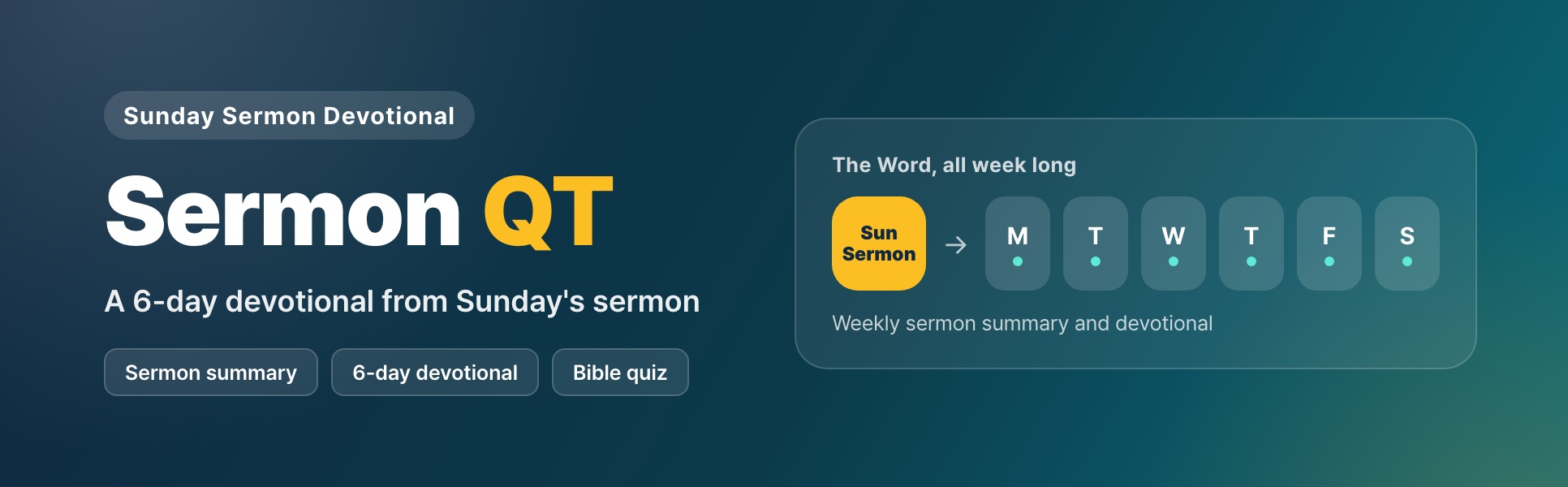
- This Week's Devotions🔒
- Monday · God's Silence
- Tuesday · God's Way of Love
- Wednesday · God's Omnipotence
- Thursday · The Meaning of Suffering
- Friday · God's Plan
- Saturday · Hope of Resurrection
- Check Your Understanding 5 questions🔒
- Full Transcript about 18,640 characters🔒
- Study Guide🔒
- 4 key points
- 4 discussion questions
- Life application
- Closing prayer
- Printable PDF (devotional, quiz, study guide)
The video, Bible passage and summary are free for everyone. A personal subscription unlocks devotional materials for every church's sermons.
- 6-day devotional (Mon–Sat)
- Full sermon transcript and outline
- Comprehension quiz
- Study guide and printable PDF