We have the amazing truth that there is no condemnation for those who are in Christ Jesus. This word shows us the way to be free from past sins and wounds.
1. There is therefore now no condemnation to those who are in Christ Jesus, who don’t walk according to the flesh, but according to the Spirit. 2. For the law of the Spirit of life in Christ Jesus made me free from the law of sin …
Romans 8 declares that through the power of the Holy Spirit, condemnation has ended. Those of us who are in Christ are never condemned, and God's love and grace are given equally regardless of our individual circumstances. This message gives us hope that no matter what difficulties we face, God will protect us and accept us as His children. Therefore, we can break free from the guilt of the past and live our present lives joyfully.
- Romans 8 1. There is therefore now no condemnation to those who are in Christ Jesus, who don’t walk according to the flesh, but according to the Spirit. 2. For the law of the Spirit of life in Christ Jesus made me free from the law of sin and of death. 3. For what the law couldn’t do, in that it was weak through the flesh, God did, sending his own Son in the likeness of sinful flesh and for sin, he condemned sin in the flesh; 4. that the ordinance of the law might be fulfilled in us, who walk not after the flesh, but after the Spirit. 5. For those who live according to the flesh set their minds on the things of the flesh, but those who live according to the Spirit, the things of the Spirit. 6. For the mind of the flesh is death, but the mind of the Spirit is life and peace; 7. because the mind of the flesh is hostile towards God; for it is not subject to God’s law, neither indeed can it be. 8. Those who are in the flesh can’t please God. 9. But you are not in the flesh but in the Spirit, if it is so that the Spirit of God dwells in you. But if any man doesn’t have the Spirit of Christ, he is not his. 10. If Christ is in you, the body is dead because of sin, but the spirit is alive because of righteousness. 11. But if the Spirit of him who raised up Jesus from the dead dwells in you, he who raised up Christ Jesus from the dead will also give life to your mortal bodies through his Spirit who dwells in you. 12. So then, brothers, we are debtors, not to the flesh, to live after the flesh. 13. For if you live after the flesh, you must die; but if by the Spirit you put to death the deeds of the body, you will live. 14. For as many as are led by the Spirit of God, these are children of God. 15. For you didn’t receive the spirit of bondage again to fear, but you received the Spirit of adoption, by whom we cry, “Abba! Father!” 16. The Spirit himself testifies with our spirit that we are children of God; 17. and if children, then heirs; heirs of God, and joint heirs with Christ; if indeed we suffer with him, that we may also be glorified with him. 18. For I consider that the sufferings of this present time are not worthy to be compared with the glory which will be revealed toward us. 19. For the creation waits with eager expectation for the children of God to be revealed. 20. For the creation was subjected to vanity, not of its own will, but because of him who subjected it, in hope 21. that the creation itself also will be delivered from the bondage of decay into the liberty of the glory of the children of God. 22. For we know that the whole creation groans and travails in pain together until now. 23. Not only so, but ourselves also, who have the first fruits of the Spirit, even we ourselves groan within ourselves, waiting for adoption, the redemption of our body. 24. For we were saved in hope, but hope that is seen is not hope. For who hopes for that which he sees? 25. But if we hope for that which we don’t see, we wait for it with patience. 26. In the same way, the Spirit also helps our weaknesses, for we don’t know how to pray as we ought. But the Spirit himself makes intercession for us with groanings which can’t be uttered. 27. He who searches the hearts knows what is on the Spirit’s mind, because he makes intercession for the saints according to God. 28. We know that all things work together for good for those who love God, to those who are called according to his purpose. 29. For whom he foreknew, he also predestined to be conformed to the image of his Son, that he might be the firstborn among many brothers. 30. Whom he predestined, those he also called. Whom he called, those he also justified. Whom he justified, those he also glorified. 31. What then shall we say about these things? If God is for us, who can be against us? 32. He who didn’t spare his own Son, but delivered him up for us all, how would he not also with him freely give us all things? 33. Who could bring a charge against God’s chosen ones? It is God who justifies. 34. Who is he who condemns? It is Christ who died, yes rather, who was raised from the dead, who is at the right hand of God, who also makes intercession for us. 35. Who shall separate us from the love of Christ? Could oppression, or anguish, or persecution, or famine, or nakedness, or peril, or sword? 36. Even as it is written, “For your sake we are killed all day long. We were accounted as sheep for the slaughter.” 37. No, in all these things, we are more than conquerors through him who loved us. 38. For I am persuaded, that neither death, nor life, nor angels, nor principalities, nor things present, nor things to come, nor powers, 39. nor height, nor depth, nor any other created thing, will be able to separate us from the love of God, which is in Christ Jesus our Lord.
- Romans 7 1. Or don’t you know, brothers (for I speak to men who know the law), that the law has dominion over a man for as long as he lives? 2. For the woman that has a husband is bound by law to the husband while he lives, but if the husband dies, she is discharged from the law of the husband. 3. So then if, while the husband lives, she is joined to another man, she would be called an adulteress. But if the husband dies, she is free from the law, so that she is no adulteress, though she is joined to another man. 4. Therefore, my brothers, you also were made dead to the law through the body of Christ, that you would be joined to another, to him who was raised from the dead, that we might produce fruit to God. 5. For when we were in the flesh, the sinful passions which were through the law, worked in our members to bring out fruit to death. 6. But now we have been discharged from the law, having died to that in which we were held; so that we serve in newness of the spirit, and not in oldness of the letter. 7. What shall we say then? Is the law sin? May it never be! However, I wouldn’t have known sin, except through the law. For I wouldn’t have known coveting, unless the law had said, “You shall not covet.” 8. But sin, finding occasion through the commandment, produced in me all kinds of coveting. For apart from the law, sin is dead. 9. I was alive apart from the law once, but when the commandment came, sin revived, and I died. 10. The commandment, which was for life, this I found to be for death; 11. for sin, finding occasion through the commandment, deceived me, and through it killed me. 12. Therefore the law indeed is holy, and the commandment holy, and righteous, and good. 13. Did then that which is good become death to me? May it never be! But sin, that it might be shown to be sin, by working death to me through that which is good; that through the commandment sin might become exceedingly sinful. 14. For we know that the law is spiritual, but I am fleshly, sold under sin. 15. For I don’t know what I am doing. For I don’t practice what I desire to do; but what I hate, that I do. 16. But if what I don’t desire, that I do, I consent to the law that it is good. 17. So now it is no more I that do it, but sin which dwells in me. 18. For I know that in me, that is, in my flesh, dwells no good thing. For desire is present with me, but I don’t find it doing that which is good. 19. For the good which I desire, I don’t do; but the evil which I don’t desire, that I practice. 20. But if what I don’t desire, that I do, it is no more I that do it, but sin which dwells in me. 21. I find then the law, that, to me, while I desire to do good, evil is present. 22. For I delight in God’s law after the inward man, 23. but I see a different law in my members, warring against the law of my mind, and bringing me into captivity under the law of sin which is in my members. 24. What a wretched man I am! Who will deliver me out of the body of this death? 25. I thank God through Jesus Christ, our Lord! So then with the mind, I myself serve God’s law, but with the flesh, the sin’s law.
- Romans 8:1 1. There is therefore now no condemnation to those who are in Christ Jesus, who don’t walk according to the flesh, but according to the Spirit.
- Romans 4 1. What then will we say that Abraham, our forefather, has found according to the flesh? 2. For if Abraham was justified by works, he has something to boast about, but not toward God. 3. For what does the Scripture say? “Abraham believed God, and it was accounted to him for righteousness.” 4. Now to him who works, the reward is not counted as grace, but as something owed. 5. But to him who doesn’t work, but believes in him who justifies the ungodly, his faith is accounted for righteousness. 6. Even as David also pronounces blessing on the man to whom God counts righteousness apart from works, 7. “Blessed are they whose iniquities are forgiven, whose sins are covered. 8. Blessed is the man whom the Lord will by no means charge with sin.” 9. Is this blessing then pronounced on the circumcised, or on the uncircumcised also? For we say that faith was accounted to Abraham for righteousness. 10. How then was it counted? When he was in circumcision, or in uncircumcision? Not in circumcision, but in uncircumcision. 11. He received the sign of circumcision, a seal of the righteousness of the faith which he had while he was in uncircumcision, that he might be the father of all those who believe, though they might be in uncircumcision, that righteousness might also be accounted to them. 12. He is the father of circumcision to those who not only are of the circumcision, but who also walk in the steps of that faith of our father Abraham, which he had in uncircumcision. 13. For the promise to Abraham and to his seed that he should be heir of the world wasn’t through the law, but through the righteousness of faith. 14. For if those who are of the law are heirs, faith is made void, and the promise is made of no effect. 15. For the law works wrath, for where there is no law, neither is there disobedience. 16. For this cause it is of faith, that it may be according to grace, to the end that the promise may be sure to all the seed, not to that only which is of the law, but to that also which is of the faith of Abraham, who is the father of us all. 17. As it is written, “I have made you a father of many nations.” This is in the presence of him whom he believed: God, who gives life to the dead, and calls the things that are not, as though they were. 18. Who in hope believed against hope, to the end that he might become a father of many nations, according to that which had been spoken, “So will your seed be.” 19. Without being weakened in faith, he didn’t consider his own body, already having been worn out, (he being about a hundred years old), and the deadness of Sarah’s womb. 20. Yet, looking to the promise of God, he didn’t waver through unbelief, but grew strong through faith, giving glory to God, 21. and being fully assured that what he had promised, he was also able to perform. 22. Therefore it also was “reckoned to him for righteousness.” 23. Now it was not written that it was accounted to him for his sake alone, 24. but for our sake also, to whom it will be accounted, who believe in him who raised Jesus, our Lord, from the dead, 25. who was delivered up for our trespasses, and was raised for our justification.
The Power of the Holy Spirit: Condemnation is Over
- There is No Condemnation
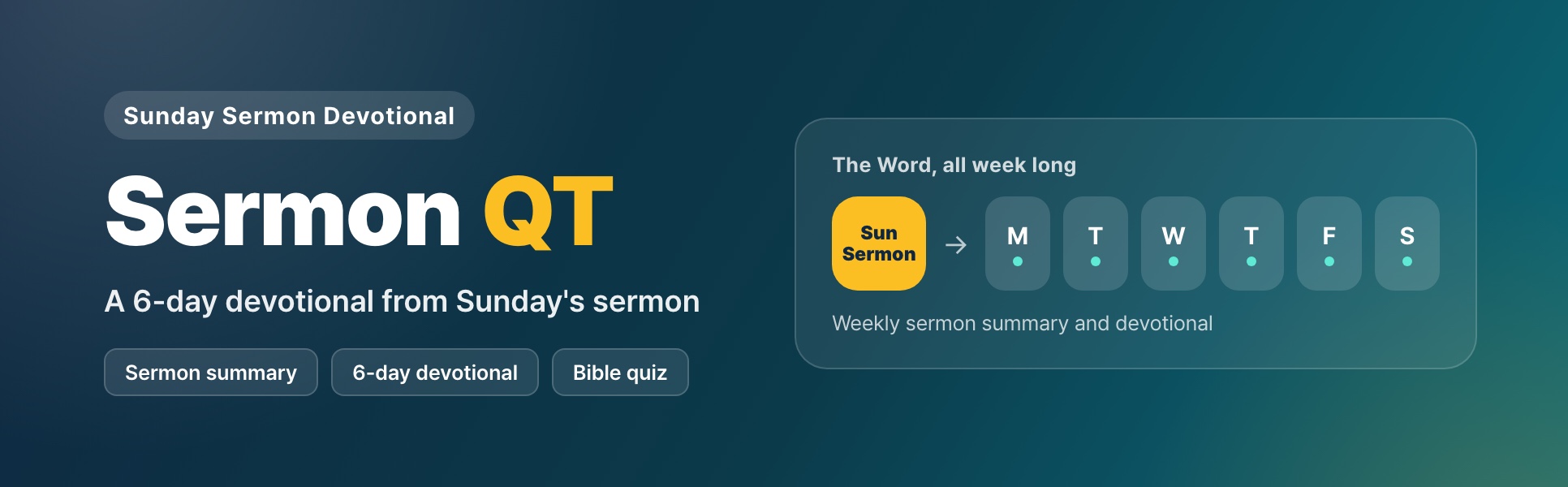
Six days of devotions drawn from this Sunday's sermon — one for each day, Monday through Saturday.
Five quick questions from this Sunday's message. Tap an answer to see if you're right.
-
What is the main theme emphasized in Romans 8?
Romans 8 emphasizes that the end of condemnation is through the power of the Holy Spirit and declares freedom in Christ.
Finally, we have arrived at Romans 8. I am very grateful, but I wonder how you all feel. Today is Romans 8 Sunday. In my youth, Romans 8 was a guiding light in my life. In the latter part of Romans 7, it says, "Oh, wretched man that I am! Who will deliver me from this body of death?" In such a despairing situation, Romans 8 helped me to overcome the walls of my life and to leap over the pits and traps of my existence. With this grace, I share today’s message, and Romans 8 is filled with the word "Holy Spirit." To put it strongly, it is plastered with the Holy Spirit. Therefore, I have titled today’s sermon "The End of Condemnation by the Power of the Holy Spirit." How is condemnation? It is over.
This Romans 8 has a particularly overwhelming history in our church as well. Eighteen years ago, our Gangnam worship hall was so small that we decided to rent the Jamsil Gymnasium for our 30th anniversary. We held three services there, and the gymnasium, which could hold 19,000 to 20,000 people, was almost filled with children at every service. One of the most meaningful things about the 30th anniversary service was that all the ministry team members and cell group leaders gathered to powerfully proclaim Romans 8 with the sound of a trumpet and drums. I also remember that on the 30th anniversary, Pastor Ok gave a sermon, and we shared the preaching. Pastor Ok said, "For the 30th anniversary, I will preach for 25 minutes since I have been here for 25 years, and you will preach for 5 minutes since you have been here for 5 years." I remember that, but what remains more fervently in my heart is the moment when all our ministry team members and cell group leaders proclaimed Romans 8 with the sound of drums. I looked for that material, and it is not well preserved, but it is not digital. The screen is a bit blurry, but I wanted to show you a brief clip for about 10 seconds. Is that okay? I usually don’t do this because if I show videos, the sermon doesn’t remain, only the video does, but since today is a precious time for Romans 8, I will show it.
"The end has come. Romans 8:1-4. Therefore, there is now no condemnation for those who are in Christ Jesus." Why could thousands of people memorize Romans 8? The reason is that Romans 8 provides an all-around answer to the many troubles of our lives. Even when your love for the Lord grows cold, when your faith weakens, when you are shaken by guilt and fear, when you are disappointed because of unanswered prayers, there are countless stories. Even when fear and depression arise, when young people are tempted by the desires of the flesh, in any case, when hope fades and the future seems unclear, in any situation, I believe that Romans 8 will be a prescription for the troubles of our lives. Amen.
Free until January 10, 2027. Sign in or just leave your email to unlock Tuesday–Saturday devotionals, the full transcript and quiz.
Sign in and view nowUnsubscribe anytime from the link in each email. Already subscribed? Open the link in your email.
