Moses asks the people of Israel where their interests lie. We must realize that our interests shape our lives and ultimately influence our choices and outcomes.
4. Hear, Israel: Yahweh is our God. Yahweh is one.
Moses' sermon can be summarized as a question about what our interests are. He encourages us to reflect on what we prioritize in our daily lives and emphasizes that these interests can bring either blessings or curses to our lives. While interests in worldly things may provide temporary satisfaction, he reminds us that they are ultimately not eternal, urging us to focus on our relationship with God. The message conveys that placing our interests in God and living according to His word leads to true blessings.
Every Monday morning: this week's sermon and 6-day devotional. Free, unsubscribe anytime.
Unsubscribe anytime from the link in each email. Already subscribed? Open the link in your email.
- Deuteronomy 6:4 4. Hear, Israel: Yahweh is our God. Yahweh is one.
- John 3:16 16. For God so loved the world, that he gave his one and only Son, that whoever believes in him should not perish, but have eternal life.
- John 6 1. After these things, Jesus went away to the other side of the sea of Galilee, which is also called the Sea of Tiberias. 2. A great multitude followed him, because they saw his signs which he did on those who were sick. 3. Jesus went up into the mountain, and he sat there with his disciples. 4. Now the Passover, the feast of the Jews, was at hand. 5. Jesus therefore lifting up his eyes, and seeing that a great multitude was coming to him, said to Philip, “Where are we to buy bread, that these may eat?” 6. This he said to test him, for he himself knew what he would do. 7. Philip answered him, “Two hundred denarii worth of bread is not sufficient for them, that everyone of them may receive a little.” 8. One of his disciples, Andrew, Simon Peter’s brother, said to him, 9. “There is a boy here who has five barley loaves and two fish, but what are these among so many?” 10. Jesus said, “Have the people sit down.” Now there was much grass in that place. So the men sat down, in number about five thousand. 11. Jesus took the loaves; and having given thanks, he distributed to the disciples, and the disciples to those who were sitting down; likewise also of the fish as much as they desired. 12. When they were filled, he said to his disciples, “Gather up the broken pieces which are left over, that nothing be lost.” 13. So they gathered them up, and filled twelve baskets with broken pieces from the five barley loaves, which were left over by those who had eaten. 14. When therefore the people saw the sign which Jesus did, they said, “This is truly the prophet who comes into the world.” 15. Jesus therefore, perceiving that they were about to come and take him by force, to make him king, withdrew again to the mountain by himself. 16. When evening came, his disciples went down to the sea, 17. and they entered into the boat, and were going over the sea to Capernaum. It was now dark, and Jesus had not come to them. 18. The sea was tossed by a great wind blowing. 19. When therefore they had rowed about twenty-five or thirty stadia, they saw Jesus walking on the sea, and drawing near to the boat; and they were afraid. 20. But he said to them, “It is I. Don’t be afraid.” 21. They were willing therefore to receive him into the boat. Immediately the boat was at the land where they were going. 22. On the next day, the multitude that stood on the other side of the sea saw that there was no other boat there, except the one in which his disciples had embarked, and that Jesus hadn’t entered with his disciples into the boat, but his disciples had gone away alone. 23. However boats from Tiberias came near to the place where they ate the bread after the Lord had given thanks. 24. When the multitude therefore saw that Jesus wasn’t there, nor his disciples, they themselves got into the boats, and came to Capernaum, seeking Jesus. 25. When they found him on the other side of the sea, they asked him, “Rabbi, when did you come here?” 26. Jesus answered them, “Most certainly I tell you, you seek me, not because you saw signs, but because you ate of the loaves, and were filled. 27. Don’t work for the food which perishes, but for the food which remains to eternal life, which the Son of Man will give to you. For God the Father has sealed him.” 28. They said therefore to him, “What must we do, that we may work the works of God?” 29. Jesus answered them, “This is the work of God, that you believe in him whom he has sent.” 30. They said therefore to him, “What then do you do for a sign, that we may see, and believe you? What work do you do? 31. Our fathers ate the manna in the wilderness. As it is written, ‘He gave them bread out of heaven to eat.’” 32. Jesus therefore said to them, “Most certainly, I tell you, it wasn’t Moses who gave you the bread out of heaven, but my Father gives you the true bread out of heaven. 33. For the bread of God is that which comes down out of heaven, and gives life to the world.” 34. They said therefore to him, “Lord, always give us this bread.” 35. Jesus said to them, “I am the bread of life. He who comes to me will not be hungry, and he who believes in me will never be thirsty. 36. But I told you that you have seen me, and yet you don’t believe. 37. All those whom the Father gives me will come to me. He who comes to me I will in no way throw out. 38. For I have come down from heaven, not to do my own will, but the will of him who sent me. 39. This is the will of my Father who sent me, that of all he has given to me I should lose nothing, but should raise him up at the last day. 40. This is the will of the one who sent me, that everyone who sees the Son, and believes in him, should have eternal life; and I will raise him up at the last day.” 41. The Jews therefore murmured concerning him, because he said, “I am the bread which came down out of heaven.” 42. They said, “Isn’t this Jesus, the son of Joseph, whose father and mother we know? How then does he say, ‘I have come down out of heaven?’” 43. Therefore Jesus answered them, “Don’t murmur among yourselves. 44. No one can come to me unless the Father who sent me draws him, and I will raise him up in the last day. 45. It is written in the prophets, ‘They will all be taught by God.’ Therefore everyone who hears from the Father, and has learned, comes to me. 46. Not that anyone has seen the Father, except he who is from God. He has seen the Father. 47. Most certainly, I tell you, he who believes in me has eternal life. 48. I am the bread of life. 49. Your fathers ate the manna in the wilderness, and they died. 50. This is the bread which comes down out of heaven, that anyone may eat of it and not die. 51. I am the living bread which came down out of heaven. If anyone eats of this bread, he will live forever. Yes, the bread which I will give for the life of the world is my flesh.” 52. The Jews therefore contended with one another, saying, “How can this man give us his flesh to eat?” 53. Jesus therefore said to them, “Most certainly I tell you, unless you eat the flesh of the Son of Man and drink his blood, you don’t have life in yourselves. 54. He who eats my flesh and drinks my blood has eternal life, and I will raise him up at the last day. 55. For my flesh is food indeed, and my blood is drink indeed. 56. He who eats my flesh and drinks my blood lives in me, and I in him. 57. As the living Father sent me, and I live because of the Father; so he who feeds on me, he will also live because of me. 58. This is the bread which came down out of heaven—not as our fathers ate the manna, and died. He who eats this bread will live forever.” 59. He said these things in the synagogue, as he taught in Capernaum. 60. Therefore many of his disciples, when they heard this, said, “This is a hard saying! Who can listen to it?” 61. But Jesus knowing in himself that his disciples murmured at this, said to them, “Does this cause you to stumble? 62. Then what if you would see the Son of Man ascending to where he was before? 63. It is the spirit who gives life. The flesh profits nothing. The words that I speak to you are spirit, and are life. 64. But there are some of you who don’t believe.” For Jesus knew from the beginning who they were who didn’t believe, and who it was who would betray him. 65. He said, “For this cause have I said to you that no one can come to me, unless it is given to him by my Father.” 66. At this, many of his disciples went back, and walked no more with him. 67. Jesus said therefore to the twelve, “You don’t also want to go away, do you?” 68. Simon Peter answered him, “Lord, to whom would we go? You have the words of eternal life. 69. We have come to believe and know that you are the Christ, the Son of the living God.” 70. Jesus answered them, “Didn’t I choose you, the twelve, and one of you is a devil?” 71. Now he spoke of Judas, the son of Simon Iscariot, for it was he who would betray him, being one of the twelve.
- John 1 1. In the beginning was the Word, and the Word was with God, and the Word was God. 2. The same was in the beginning with God. 3. All things were made through him. Without him was not anything made that has been made. 4. In him was life, and the life was the light of men. 5. The light shines in the darkness, and the darkness hasn’t overcome it. 6. There came a man, sent from God, whose name was John. 7. The same came as a witness, that he might testify about the light, that all might believe through him. 8. He was not the light, but was sent that he might testify about the light. 9. The true light that enlightens everyone was coming into the world. 10. He was in the world, and the world was made through him, and the world didn’t recognize him. 11. He came to his own, and those who were his own didn’t receive him. 12. But as many as received him, to them he gave the right to become God’s children, to those who believe in his name: 13. who were born not of blood, nor of the will of the flesh, nor of the will of man, but of God. 14. The Word became flesh, and lived among us. We saw his glory, such glory as of the one and only Son of the Father, full of grace and truth. 15. John testified about him. He cried out, saying, “This was he of whom I said, ‘He who comes after me has surpassed me, for he was before me.’” 16. From his fullness we all received grace upon grace. 17. For the law was given through Moses. Grace and truth were realized through Jesus Christ. 18. No one has seen God at any time. The one and only Son, who is in the bosom of the Father, he has declared him. 19. This is John’s testimony, when the Jews sent priests and Levites from Jerusalem to ask him, “Who are you?” 20. He declared, and didn’t deny, but he declared, “I am not the Christ.” 21. They asked him, “What then? Are you Elijah?” He said, “I am not.” “Are you the prophet?” He answered, “No.” 22. They said therefore to him, “Who are you? Give us an answer to take back to those who sent us. What do you say about yourself?” 23. He said, “I am the voice of one crying in the wilderness, ‘Make straight the way of the Lord,’ as Isaiah the prophet said.” 24. The ones who had been sent were from the Pharisees. 25. They asked him, “Why then do you baptize, if you are not the Christ, nor Elijah, nor the prophet?” 26. John answered them, “I baptize in water, but among you stands one whom you don’t know. 27. He is the one who comes after me, who is preferred before me, whose sandal strap I’m not worthy to loosen.” 28. These things were done in Bethany beyond the Jordan, where John was baptizing. 29. The next day, he saw Jesus coming to him, and said, “Behold, the Lamb of God, who takes away the sin of the world! 30. This is he of whom I said, ‘After me comes a man who is preferred before me, for he was before me.’ 31. I didn’t know him, but for this reason I came baptizing in water: that he would be revealed to Israel.” 32. John testified, saying, “I have seen the Spirit descending like a dove out of heaven, and it remained on him. 33. I didn’t recognize him, but he who sent me to baptize in water, he said to me, ‘On whomever you will see the Spirit descending, and remaining on him, the same is he who baptizes in the Holy Spirit.’ 34. I have seen, and have testified that this is the Son of God.” 35. Again, the next day, John was standing with two of his disciples, 36. and he looked at Jesus as he walked, and said, “Behold, the Lamb of God!” 37. The two disciples heard him speak, and they followed Jesus. 38. Jesus turned, and saw them following, and said to them, “What are you looking for?” They said to him, “Rabbi” (which is to say, being interpreted, Teacher), “where are you staying?” 39. He said to them, “Come, and see.” They came and saw where he was staying, and they stayed with him that day. It was about the tenth hour. 40. One of the two who heard John, and followed him, was Andrew, Simon Peter’s brother. 41. He first found his own brother, Simon, and said to him, “We have found the Messiah!” (which is, being interpreted, Christ). 42. He brought him to Jesus. Jesus looked at him, and said, “You are Simon the son of Jonah. You shall be called Cephas” (which is by interpretation, Peter). 43. On the next day, he was determined to go out into Galilee, and he found Philip. Jesus said to him, “Follow me.” 44. Now Philip was from Bethsaida, of the city of Andrew and Peter. 45. Philip found Nathanael, and said to him, “We have found him, of whom Moses in the law, and the prophets, wrote: Jesus of Nazareth, the son of Joseph.” 46. Nathanael said to him, “Can any good thing come out of Nazareth?” Philip said to him, “Come and see.” 47. Jesus saw Nathanael coming to him, and said about him, “Behold, an Israelite indeed, in whom is no deceit!” 48. Nathanael said to him, “How do you know me?” Jesus answered him, “Before Philip called you, when you were under the fig tree, I saw you.” 49. Nathanael answered him, “Rabbi, you are the Son of God! You are King of Israel!” 50. Jesus answered him, “Because I told you, ‘I saw you underneath the fig tree,’ do you believe? You will see greater things than these!” 51. He said to him, “Most certainly, I tell you, hereafter you will see heaven opened, and the angels of God ascending and descending on the Son of Man.”
- Colossians 3 1. If then you were raised together with Christ, seek the things that are above, where Christ is, seated on the right hand of God. 2. Set your mind on the things that are above, not on the things that are on the earth. 3. For you died, and your life is hidden with Christ in God. 4. When Christ, our life, is revealed, then you will also be revealed with him in glory. 5. Put to death therefore your members which are on the earth: sexual immorality, uncleanness, depraved passion, evil desire, and covetousness, which is idolatry; 6. for which things’ sake the wrath of God comes on the children of disobedience. 7. You also once walked in those, when you lived in them; 8. but now you also put them all away: anger, wrath, malice, slander, and shameful speaking out of your mouth. 9. Don’t lie to one another, seeing that you have put off the old man with his doings, 10. and have put on the new man, who is being renewed in knowledge after the image of his Creator, 11. where there can’t be Greek and Jew, circumcision and uncircumcision, barbarian, Scythian, bondservant, freeman; but Christ is all, and in all. 12. Put on therefore, as God’s chosen ones, holy and beloved, a heart of compassion, kindness, lowliness, humility, and perseverance; 13. bearing with one another, and forgiving each other, if any man has a complaint against any; even as Christ forgave you, so you also do. 14. Above all these things, walk in love, which is the bond of perfection. 15. And let the peace of God rule in your hearts, to which also you were called in one body; and be thankful. 16. Let the word of Christ dwell in you richly; in all wisdom teaching and admonishing one another with psalms, hymns, and spiritual songs, singing with grace in your heart to the Lord. 17. Whatever you do, in word or in deed, do all in the name of the Lord Jesus, giving thanks to God the Father, through him. 18. Wives, be in subjection to your husbands, as is fitting in the Lord. 19. Husbands, love your wives, and don’t be bitter against them. 20. Children, obey your parents in all things, for this pleases the Lord. 21. Fathers, don’t provoke your children, so that they won’t be discouraged. 22. Servants, obey in all things those who are your masters according to the flesh, not just when they are looking, as men pleasers, but in singleness of heart, fearing God. 23. And whatever you do, work heartily, as for the Lord, and not for men, 24. knowing that from the Lord you will receive the reward of the inheritance; for you serve the Lord Christ. 25. But he who does wrong will receive again for the wrong that he has done, and there is no partiality.
- Deuteronomy 5 1. Moses called to all Israel, and said to them, “Hear, Israel, the statutes and the ordinances which I speak in your ears this day, that you may learn them, and observe to do them.” 2. Yahweh our God made a covenant with us in Horeb. 3. Yahweh didn’t make this covenant with our fathers, but with us, even us, who are all of us here alive this day. 4. Yahweh spoke with you face to face on the mountain out of the midst of the fire, 5. (I stood between Yahweh and you at that time, to show you Yahweh’s word: for you were afraid because of the fire, and didn’t go up onto the mountain;) saying, 6. “I am Yahweh your God, who brought you out of the land of Egypt, out of the house of bondage. 7. “You shall have no other gods before me. 8. “You shall not make an engraved image for yourself, any likeness of what is in heaven above, or what is in the earth beneath, or that is in the water under the earth. 9. You shall not bow yourself down to them, nor serve them; for I, Yahweh, your God, am a jealous God, visiting the iniquity of the fathers on the children, and on the third and on the fourth generation of those who hate me; 10. and showing loving kindness to thousands of those who love me and keep my commandments. 11. “You shall not take the name of Yahweh your God in vain: for Yahweh will not hold him guiltless who takes his name in vain. 12. “Observe the Sabbath day, to keep it holy, as Yahweh your God commanded you. 13. You shall labor six days, and do all your work; 14. but the seventh day is a Sabbath to Yahweh your God, in which you shall not do any work, you, nor your son, nor your daughter, nor your male servant, nor your female servant, nor your ox, nor your donkey, nor any of your livestock, nor your stranger who is within your gates; that your male servant and your female servant may rest as well as you. 15. You shall remember that you were a servant in the land of Egypt, and Yahweh your God brought you out of there by a mighty hand and by an outstretched arm. Therefore Yahweh your God commanded you to keep the Sabbath day. 16. “Honor your father and your mother, as Yahweh your God commanded you; that your days may be long, and that it may go well with you, in the land which Yahweh your God gives you. 17. “You shall not murder. 18. “You shall not commit adultery. 19. “You shall not steal. 20. “You shall not give false testimony against your neighbor. 21. “You shall not covet your neighbor’s wife. Neither shall you desire your neighbor’s house, his field, or his male servant, or his female servant, his ox, or his donkey, or anything that is your neighbor’s.” 22. Yahweh spoke these words to all your assembly on the mountain out of the midst of the fire, of the cloud, and of the thick darkness, with a great voice. He added no more. He wrote them on two stone tablets, and gave them to me. 23. When you heard the voice out of the midst of the darkness, while the mountain was burning with fire, you came near to me, even all the heads of your tribes, and your elders; 24. and you said, “Behold, Yahweh our God has shown us his glory and his greatness, and we have heard his voice out of the midst of the fire. We have seen this day that God does speak with man, and he lives. 25. Now therefore why should we die? For this great fire will consume us. If we hear the voice of Yahweh our God any more, then we shall die. 26. For who is there of all flesh, that has heard the voice of the living God speaking out of the midst of the fire, as we have, and lived? 27. Go near, and hear all that Yahweh our God shall say, and tell us all that Yahweh our God tells you; and we will hear it, and do it.” 28. Yahweh heard the voice of your words, when you spoke to me; and Yahweh said to me, “I have heard the voice of the words of this people, which they have spoken to you. They have well said all that they have spoken. 29. Oh that there were such a heart in them, that they would fear me, and keep all my commandments always, that it might be well with them, and with their children forever! 30. “Go tell them, ‘Return to your tents.’ 31. But as for you, stand here by me, and I will tell you all the commandment, and the statutes, and the ordinances, which you shall teach them, that they may do them in the land which I give them to possess it.” 32. You shall observe to do therefore as Yahweh your God has commanded you. You shall not turn aside to the right hand or to the left. 33. You shall walk in all the way which Yahweh your God has commanded you, that you may live, and that it may be well with you, and that you may prolong your days in the land which you shall possess.
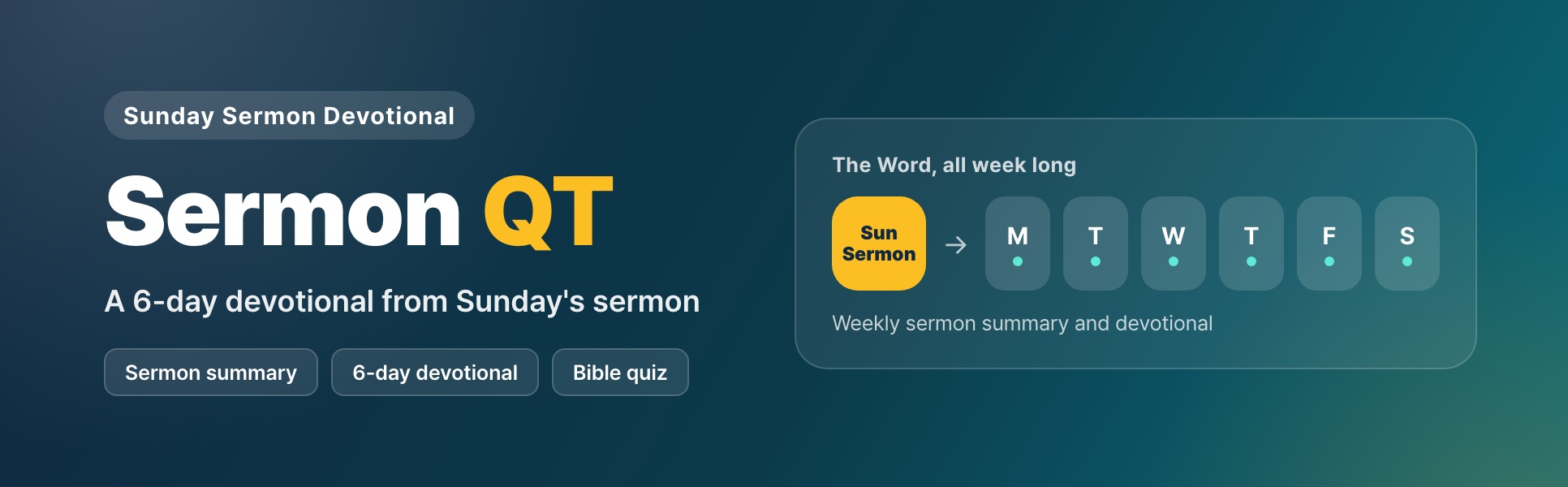
Six days of devotions drawn from this Sunday's sermon — one for each day, Monday through Saturday.
God desires our hearts to be focused on our relationship with Him. Where our interest lies, our hearts will follow, deepening our relationships.
Misplaced interests ultimately lead to curses and unhappiness. If we only focus on worldly things, our souls will suffer.
God promises to restore us whenever we return to Him. When our interests turn back to God, He gathers us again.
Moses urges us to choose between life and death, blessings and curses. Our interests should be placed on eternal matters.
When our interests change, our lives change. An interest directed towards God will renew our lives.
As a first-time visitor, you got this whole sermon free. Leave your email for the weekly sermon summary and 6-day devotional every Monday, with full access to every sermon free for 2 weeks.
Unsubscribe anytime from the link in each email. Already subscribed? Open the link in your email.
Five quick questions from this Sunday's message. Tap an answer to see if you're right.
-
What is the most important theme of Moses' three sermons?
The core theme of Moses' sermon is the question 'What is your concern?', conveying the message that it is important what one focuses on in their personal life.
-
What is the definition of concern emphasized by Moses?
Concern is a state connected to the heart, indicating what we are focusing our hearts on.
-
What outcome did Moses warn about?
Moses warned that losing concern for God could lead to being cursed, emphasizing the importance of concern.
-
What is emphasized in Deuteronomy 6:4?
Deuteronomy 6:4 emphasizes the message to love God, highlighting that our life's concern should be directed towards Him.
-
What is the final message Moses wanted to convey?
Moses emphasized to the people to return to God and urged them to properly establish their concerns.
Preacher: Pastor Il-kyu Park
Date: 2026-10-19
Chapters 34 to 30 contain the overall sermons of Moses. There are exactly three sermons. Chapters 1 to 4 constitute one sermon, chapters 5 to 26 explain the law in detail, making it the second sermon, and from chapter 27 to the end of chapter 30, which we read today, is the third sermon. Among Moses' three sermons, this is the conclusion. The conclusion of Moses' lengthy sermon can be summarized in one word, which is repeated three times in today's chapter 30. It is repeated in verse 3, then again in verse 2, and in verses 6 and 10 as well. If we include similar content, it is emphasized about six times. The core theme of this sermon, spanning chapter 30, is one. The theme of Moses' sermon is Deuteronomy 6:4-9. This is often referred to as the key verse of the entire Bible when we come to the New Testament, like John 3:16. If you were to condense the Old Testament into one line, it would be Deuteronomy 6:4-9. Moses keeps repeating this sermon. Although he expresses it in various ways, those are all just embellishments for explanation, and the core question is: What is your concern? What is your daily focus in life? What is your burning interest? This interest is what we relate to. It indicates where our connections lie. That is what interest means.
Yes, the character of interest, when viewed in Chinese characters, combines the character for "door" with two characters for "thread" beneath it, forming the term for interest. This indicates a locking mechanism. You know what it means to lock a door, right? It means preventing the door from being opened. The reason for including two threads is that in ancient times, when locking a door, it wasn't just about placing a lock; it also meant tying it with a thread or rope to ensure it couldn't be easily opened from either inside or outside. This is the kind of interest that tightly locks the door. However, since it is called interest, it uses the character for "heart." When a person's heart is connected to something, they become trapped in the relationship with that object of interest. They cannot move, just like a door that is tightly locked. This is what we refer to as having interest. Interest. People in love often say they are "in a situation" — it means they have developed an interest. Although their hearts may not yet be in sync, they are in a state of mutual interest. When sparks fly between them, they become completely absorbed, watching each other's reactions, trying to gauge whether the other likes them or not, and they become paralyzed by this interest. But what is this interest? Everyone has their own interests. What was your main concern last week? For some, it is politics. Even though they are not politicians, they immerse themselves in politics, criticizing figures like Trump and focusing entirely on political matters. Such people are truly unfortunate. When I lived in Korea, I noticed places like real estate offices where people would sit and talk about the president as casually as they would about their pet dog, engaging in political discussions. They would argue about politics after every meal, with one person supporting the president and another opposing him. I couldn't understand what they were doing. Some people, however, are indifferent to politics. They only care about money. Money is their interest. They would do anything as long as it involves making money, disregarding conscience or morals. They would say, "Don't talk about being full; just give me money." Even if they have never met someone in their life, they might take a bag of money to someone and ask them to solve a problem. Why? Because they are so focused on money that they are willing to take risks. Some people have a significant interest in health, even if they are not doctors. Like our brother Cheong-soo, who will be working as a doctor, it is fine to have an interest in health, but many people are overly concerned about it. Nowadays, doctors have to be prepared for the fact that patients come in with all sorts of information from YouTube, acting like they are half-doctors themselves. People with a strong interest in health tend to die quickly. In my experience as a pastor, I have seen that after services, when we gather for meals, there are always discussions about health. The person who talks about their health issues is often the first one whose funeral I end up conducting. It’s true. The more someone is preoccupied with health, the quicker they tend to pass away. Interests change. Some people are only concerned with beauty, wondering how they can maintain their appearance. Others are entirely focused on fame, power, and success. However, when people become fixated on worldly matters, it may feel good for a while, but it inevitably ends in unhappiness. Why? Because God curses such people, and He has set up a system that leads them automatically down the path of curses. So today, I ask you: What is your burning interest? Moses seems to have delivered many lengthy sermons while leading God's people through the wilderness for 40 years, but the conclusion is one. What is your interest? It is because of this interest that you will either live or die, be blessed or be cursed. You must set your interests correctly.
Today's content reflects this as Joshua is appointed as the successor in chapter 31. In chapter 32, Moses sings a song of praise and glory to God. [Clears throat] In chapter 33, he gathers all the people of Israel and blesses them. Then in chapter 34, Moses climbs to the top of the mountain to give his final farewell to God and dies. This is an appendix. From chapter 31 onward, the core of Moses' sermon has already been presented in chapter 30. What is the conclusion? What is your area of interest? Because of that, you will either live or die. Why? Because what I am interested in is what I believe in. What do I believe in? It is where my joy, the meaning of my life, my satisfaction, my enjoyment, and my happiness lie. That is my area of interest, which means I believe in that object of interest. However, those who are focused on earthly things, we have all lived through this. Most of us here, about 90%, have lived long enough to know: "I can't live without you," and those who fought to live when they were about to die — how does that change over time? There are limits to that. Money may seem good, and having money allows you to do and buy many things, but does it truly quench our thirst? It can provide some comfort, but the same goes for children and health. Getting into prestigious universities is the same. In the workplace, promotions seem good, but the responsibilities become heavier. The more time passes in this world, what remains unchanged? Even when God provided manna, didn't your ancestors die in the wilderness? It was said that after a day, it would spoil, smell bad, and be infested with worms, right? Therefore, seeking God and believing in Him are not the same. Many people come seeking a problem solver, but seeking and believing are entirely different. Believing means committing our lives to the unseen, while seeking means committing our lives to the visible. So, those who are full from eating bread seek Jesus because they can eat without worry. They searched all day long, and when they found Him, they exclaimed, "You were here all along!" They had been looking for Him because they wanted to eat more bread. Jesus said, "Do not labor for the food that perishes, but for the food that endures to eternal life." When they asked what this enduring food was, Jesus replied, "The work of God is to believe in Him whom He sent." This is the essence of believing in Jesus versus merely seeking Him for problem-solving. We must become people who believe in Jesus. Seeking Him for problem-solving is religion. If we believe in Jesus, He knows our problems, and we must trust that He cares for us. We are not those who seek Him for solutions; we are simply believers in the Lord. What do we believe? We believe that everything that exists on this earth exists because of Him. Whether it is an event, an object, a person, or a situation, nothing exists without His involvement. John 1 states that nothing was made without Him. Even wars belong to the Lord. Today, everything we experience unfolds under God's sovereignty, and we must believe that He governs according to His will and sovereignty. You also have an interest in what you create. When a homemaker prepares a meal, she puts her heart into it, using the best ingredients for her family. When someone enjoys that meal, it is because the cook invested her interest in it. But if someone says, "This is too salty," all that effort can feel wasted. If they say, "This is too bland," it can be adjusted, but if they say, "This is delicious," then the cook's interest is rewarded. When we praise God, we are expressing our gratitude. When we say, "Bless the Lord, O my soul," it means we are blessing God. How can we bless God? He is the one who blesses us. When we bless God, we are acknowledging that everything He has given us — every situation, event, and person — is wonderful. When we recognize this, God is glorified. Just as our parents feel blessed when we express gratitude for their sacrifices, we bless God when we acknowledge His goodness. If we firmly believe that God is overseeing everything, knowing, hearing, guiding, and governing, we can live with the assurance that even when we face incomprehensible situations, we can find resolution through the grace of Jesus' cross. There is nothing that cannot be understood in Christ. For example, if a child were to drown at the beach and someone risked their life to save them, even if that rescuer were to perish, we would never forget that person. How much more should we remember God, who created the universe and suffered on the cross for us? When we focus on the cross, we stop being distracted by trivial matters. We need to redirect our hearts. This is what circumcision means. In the New Testament, circumcision refers to shedding the flesh. Paul mentions this in Colossians 3, where he speaks of the circumcision of the heart. We need to receive this heart circumcision. We often pay too much attention to trivial matters. Some people are obsessed with hobbies, like fishing. They disregard their spouses and children, heading straight to the fishing spot after work on Fridays and returning to work on Mondays. This obsession consumes a lot of money. A single fishing rod can cost over a thousand dollars. Those who pour all their interest into such things will end up living their lives without fulfillment. No matter how good something seems in this world, it will eventually decay and lose its appeal. After some time, even the best food will lose its flavor. Therefore, no matter how good something may seem, nothing is eternal. What Moses ultimately wants to convey is to focus on what is imperishable, unfading, and eternal. He emphasizes this clearly in verse 2. Let's read verse 2 together. "You and your children shall return to the Lord your God and obey His voice in all that I command you today, with all your heart and with all your soul." Indeed, he returns to Deuteronomy 6:4. In verse 1, Moses is speaking about the future, even though they have not yet entered the land of Canaan. He is prophesying about what will happen. He warns that if they lose interest in God and become consumed by earthly matters, they will ultimately face destruction, defeat in war, and captivity. This is a warning against what should not happen. In 721 BC, before Jesus came, the northern kingdom of Israel was completely destroyed and taken captive by Assyria. Assyria's policy was to scatter the people rather than keep them together. They brought in foreigners to occupy the land where the ten tribes of Israel had lived. Thus, during Jesus' time, the people in Samaria were not recognized as Jews. The Samaritan woman was surprised when Jesus, a Jewish man, asked her for a drink. No one would associate with her because the bloodlines had mixed, and there was no longer any obedience. Assyria completely wiped out the northern kingdom of Israel. Only Judah remained. In 586 BC, Babylon, having conquered Assyria, became the world power and destroyed Judah, leading to the fall of Jerusalem and the burning of the temple. They took all the healthy people, including children and homemakers, into captivity for 70 years. This became a reality. Yet, when Moses spoke, it had not yet happened. In chapter 30, verse 1, he states that all the blessings and curses he has been preaching about are now upon them. If they remember these things in the lands where they are scattered, he warns them that if they turn back to the Lord, they will be restored. This is a call to change their focus. They must return to God, loving Him with all their heart and soul. What does the text say in verse 4? Let's read it together. "Even if your outcasts are at the ends of the earth, from there the Lord your God will gather you, and from there He will take you." Where is the "ends of the earth"? It refers to the horizon. Even if you have wandered far away from me, if you repent and turn back, I will gather you back to the promised land. What does Moses' conclusion mean for us today? What does it say to us, who live in this land? It speaks to how far or close we are to God. Are you not a prisoner of your interests? What has captured your heart? It is as if you are dwelling at the ends of the earth, far from God. If your interest is not in God but in earthly things, then you are far from Him, and your heart is held captive. Those who live like this will inevitably begin a life of unhappiness and ultimately end in despair. So, when we see people going around preaching happiness, we call them happiness evangelists. Nowadays, do you watch TV? Suddenly, someone becomes a counselor and gathers a crowd to give a talk on solving life's problems. They become very popular, and large companies invite them for employee training. If you listen to their talks, where is their focus? It is on earthly matters. They beautifully package the message of earthly curses. They can earn a fortune for an hour of speaking about these cursed topics. Some even become so exhausted that they end up taking their own lives. They preach happiness while suffering from their own pain. You must realize that without a heavenly hope, any interest you have is under a curse. A person of faith can see this. Those who cannot see it continue to search for happiness, joy, meaning, and value in life, looking everywhere. But it is not there. It is an illusion, like a mirage or a rainbow. There is no happiness in this world. It exists only in our faith. Moses places the conclusion of his final sermon here. He warns that if they enter the land and lose their focus, they will surely be taken captive. Just as their ancestors did, they will face the same fate. However, if they remember his words in captivity, they must turn back to the Lord. This is the call to change their focus. They must return to God, loving Him with all their heart and soul. Then what does the text say in verses 9 and 10? Let’s read those verses together. "If you obey the voice of the Lord your God, keeping all His commandments that are written in this book of the law, and turn to the Lord your God with all your heart and with all your soul, then the Lord your God will make you abundantly prosperous in all the work of your hand, in the fruit of your womb, and in the fruit of your livestock, and in the fruit of your ground. For the Lord will again take delight in prospering you, as He took delight in your fathers." Half of this speaks of blessings, and the other half begins with "if." If you keep all the commandments from chapters 5 to 26, it is possible. But is this something we can do? The text suggests that it is possible. In verses 11 to 14, which we have not read, it states: "For this commandment that I command you today is not too hard for you, neither is it far off. It is not in heaven, that you should say, 'Who will ascend to heaven for us and bring it to us, that we may hear it and do it?' Nor is it beyond the sea, that you should say, 'Who will go over the sea for us and bring it to us, that we may hear it and do it?' But the word is very near you. It is in your mouth and in your heart, so that you can do it." It says that it is not difficult to obey all these commandments. God is saying that it is not far away. It is not in heaven or across the sea. It is very near you, in your mouth and in your heart. What does this mean? It depends on what you are interested in. The only one who has perfectly obeyed all these commandments is Jesus Christ. Therefore, when we enter into Christ, our hearts unite with God, making obedience possible. Yes, Jesus said, "If someone strikes you on the right cheek, turn to him the other also." This means that if someone strikes your right cheek, it implies they are left-handed, hitting you with their left hand. So, He is saying to turn the other cheek. How is this possible? When we are united with Christ, we die to ourselves and become one with Him. This is possible. It is not a distant command or something that requires someone to ascend to heaven or cross the sea to bring it to us. It is in our mouths and hearts. This is possible in Christ. Therefore, when Stephen was being stoned, he prayed, "Father, forgive them, for they do not know what they are doing." Jesus prayed the same prayer, and Stephen fell asleep. The Apostle Paul endured many beatings, yet he boasted in his sufferings. How is this possible? It is because he was united with Christ. Today, God has sent us Jesus Christ. Those who receive Him and unite with Him, making His events their own, will find that His death on the cross is their death. Daily, they must declare, "I have died to the world," just as the Apostle Paul did. They must hold onto the cross as their daily sustenance. This is possible because, although it may seem impossible, Christ lives in us, and God has provided this solution for us. Therefore, we must live according to the laws from Deuteronomy 5 to 26. Where? In Christ. Jesus came to fulfill the law. Daily, we must hold onto Him and receive the circumcision of the heart. We must manage our relationship with God so that we do not drift away. Our focus must be on Jesus Christ. Receiving Jesus, whom God sent, is receiving the Father, who sent Him. Every morning, when we wake up, we should declare, "Lord, I affirm before You that I am dead with You." We start our day united with Him in new life.
Today marks the 509th anniversary of the Reformation. The church began to decline 500 years ago. Until the 300s, it was a time of severe persecution, where maintaining faith required risking one's life. However, in 313 AD, Emperor Constantine declared Christianity the state religion, ending persecution. From then on, those who persecuted Christians could not survive; the situation reversed. To gain status, one had to be a Christian. Everyone in the nation began to believe in Jesus. They started building magnificent churches, adorned with gold, which are still preserved as pilgrimage sites today. From 500 years ago until 1517, the medieval period saw a decline in faith and essence, with only the outer shell remaining. Reformers like Martin Luther, Zwingli, and Thomas Müntzer risked their lives to reclaim the gospel of the cross. The answer is singular. Our sole focus must be on God the Father. This means receiving Jesus Christ, sent by God, and making His events our own. Only then can we start from God. All other religions begin with man, aiming to reach God through effort, service, and sacrifice. This is the religion created by man. However, Jesus abolished this. The reformers sought to eliminate this false religion from the church, emphasizing that we must start from God. No amount of effort, service, or sacrifice can bring us closer to God. Even if we give everything, we cannot take a single step toward Him. But through the grace of Jesus Christ, we are seated in heavenly places. We believe that He fulfilled the law, and those who enter into Christ are seated with Him in heavenly places. Starting from God is the essence of the gospel. Everything else is religion, a man-made construct. The lie that we must work hard to earn God's blessings is a false religion.
Amen. The moment we believe in Jesus Christ, we become seated in heavenly places, independent of our efforts, merits, or sacrifices. Our efforts, service, and offerings are merely evidence and fruit of being God's children. We do these things out of joy and gratitude, reflecting the grace we have received. They do not serve as reasons to draw closer to God. We must hold onto the cross daily. I saw a program on CBS where about 100 pastors were gathered, and the audience consisted of elders, deacons, and church members. They collected questions from Christian viewers and organized them to ask the pastors. I found it interesting. However, I felt a sense of disappointment. None of the pastors answered with the cross. Despite the multitude of complex life problems, the answer is singular: the cross. The cross resolves everything. If we die to ourselves, we will find solutions to our problems. If we cannot find solutions, then the death of Christ was in vain. Can anything else provide answers? It is like trying to tie a needle to your waist to use thread; it is impossible. All life’s problems are resolved in the circumcision of the heart through Jesus Christ. When we are united with Him, we will be united with God. When we love God with all our heart and soul, He begins to take an interest in us. Therefore, we must focus on God. Do not worry about your children. I have experienced that even when serious issues arise with children, it is crucial not to let your heart be consumed by those concerns. I have learned that even if serious problems arise, I must fulfill my responsibilities without letting my heart be taken away. If you let your heart be taken, you become paralyzed by that interest. Abraham never let his heart be taken by his child. He never asked for a child. Yet, when God finally gave him Isaac, He asked for him back. This is a lesson not to let your heart be consumed by your children. Do not let your health become your focus either. God is aware of everything, even the things you do not know. I have two health issues that doctors say have no cure. I thank God for this. I will live with these issues until He calls me home. I do not pray for healing. I accept that I will live with them until the end. If a doctor suggests surgery, I refuse. I have endured for 16 years without surgery. I could have had it done for free in Korea, but I choose to live with these conditions. I will go to God with these issues. From today, I encourage you to change your focus. If you focus solely on God, His heart will flow into yours, and you will realize that He cares for you.
Key Points
- Moses' sermon can be summarized with the question of what our focus is.
- What we focus on greatly influences our lives.
- Returning to God is the way to set our focus correctly.
- Focusing on worldly things ultimately leads to curses and unhappiness.
Discussion Questions
- What has been your biggest focus this week?
- How does a change in focus affect your attitude toward life?
- What does returning to God mean to you?
- What efforts can you make to direct your focus toward God?
Apply This Week
This week, I will take time each day to focus on God and meditate on His word.
Prayer & Reflection
God, help me not to focus on worldly things, and grant me a heart that can return solely to You.
