When Jesus gave thanks for the bread and fish and shared them, it reminds us that everything we have comes from God. We should have a heart of gratitude for everything in our lives.
30. The apostles gathered themselves together to Jesus, and they told him all things, whatever they had done, and whatever they had taught. 31. He said to them, “You come apart into a deserted place, and rest awhile.” For there we…
Today's message conveys that through the miracle of the five loaves and two fish, we should recognize that everything we have is by God's grace and live a life of gratitude. Jesus took the bread and fish from a child, looked up to heaven, and offered a prayer of thanks. This reminds us not to forget that everything we possess comes from God, and we should live a life of gratitude and sharing in response to that grace. I hope we can remember God's provision in our daily lives and live with a thankful heart.
- Mark 6:30-44 30. The apostles gathered themselves together to Jesus, and they told him all things, whatever they had done, and whatever they had taught. 31. He said to them, “You come apart into a deserted place, and rest awhile.” For there were many coming and going, and they had no leisure so much as to eat. 32. They went away in the boat to a deserted place by themselves. 33. They saw them going, and many recognized him and ran there on foot from all the cities. They arrived before them and came together to him. 34. Jesus came out, saw a great multitude, and he had compassion on them, because they were like sheep without a shepherd, and he began to teach them many things. 35. When it was late in the day, his disciples came to him, and said, “This place is deserted, and it is late in the day. 36. Send them away, that they may go into the surrounding country and villages, and buy themselves bread, for they have nothing to eat.” 37. But he answered them, “You give them something to eat.” They asked him, “Shall we go and buy two hundred denarii worth of bread, and give them something to eat?” 38. He said to them, “How many loaves do you have? Go see.” When they knew, they said, “Five, and two fish.” 39. He commanded them that everyone should sit down in groups on the green grass. 40. They sat down in ranks, by hundreds and by fifties. 41. He took the five loaves and the two fish, and looking up to heaven, he blessed and broke the loaves, and he gave to his disciples to set before them, and he divided the two fish among them all. 42. They all ate, and were filled. 43. They took up twelve baskets full of broken pieces and also of the fish. 44. Those who ate the loaves were five thousand men.
- Mark 6:30 30. The apostles gathered themselves together to Jesus, and they told him all things, whatever they had done, and whatever they had taught.
- Mark 6:41 41. He took the five loaves and the two fish, and looking up to heaven, he blessed and broke the loaves, and he gave to his disciples to set before them, and he divided the two fish among them all.
- 시편 104편
- Psalms 145 1. I will exalt you, my God, the King. I will praise your name forever and ever. 2. Every day I will praise you. I will extol your name forever and ever. 3. Great is Yahweh, and greatly to be praised! His greatness is unsearchable. 4. One generation will commend your works to another, and will declare your mighty acts. 5. Of the glorious majesty of your honor, of your wondrous works, I will meditate. 6. Men will speak of the might of your awesome acts. I will declare your greatness. 7. They will utter the memory of your great goodness, and will sing of your righteousness. 8. Yahweh is gracious, merciful, slow to anger, and of great loving kindness. 9. Yahweh is good to all. His tender mercies are over all his works. 10. All your works will give thanks to you, Yahweh. Your saints will extol you. 11. They will speak of the glory of your kingdom, and talk about your power; 12. to make known to the sons of men his mighty acts, the glory of the majesty of his kingdom. 13. Your kingdom is an everlasting kingdom. Your dominion endures throughout all generations. Yahweh is faithful in all his words, and loving in all his deeds. 14. Yahweh upholds all who fall, and raises up all those who are bowed down. 15. The eyes of all wait for you. You give them their food in due season. 16. You open your hand, and satisfy the desire of every living thing. 17. Yahweh is righteous in all his ways, and gracious in all his works. 18. Yahweh is near to all those who call on him, to all who call on him in truth. 19. He will fulfill the desire of those who fear him. He also will hear their cry, and will save them. 20. Yahweh preserves all those who love him, but all the wicked he will destroy. 21. My mouth will speak the praise of Yahweh. Let all flesh bless his holy name forever and ever.
- 1 Chronicles 29 1. David the king said to all the assembly, “Solomon my son, whom alone God has chosen, is yet young and tender, and the work is great; for the palace is not for man, but for Yahweh God. 2. Now I have prepared with all my might for the house of my God the gold for the things of gold, and the silver for the things of silver, and the brass for the things of brass, the iron for the things of iron, and wood for the things of wood; onyx stones, and stones to be set, stones for inlaid work, and of various colors, and all kinds of precious stones, and marble stones in abundance. 3. In addition, because I have set my affection on the house of my God, since I have a treasure of my own of gold and silver, I give it to the house of my God, over and above all that I have prepared for the holy house, 4. even three thousand talents of gold, of the gold of Ophir, and seven thousand talents of refined silver, with which to overlay the walls of the houses; 5. of gold for the things of gold, and of silver for the things of silver, and for all kinds of work to be made by the hands of artisans. Who then offers willingly to consecrate himself this day to Yahweh?” 6. Then the princes of the fathers’ households, and the princes of the tribes of Israel, and the captains of thousands and of hundreds, with the rulers over the king’s work, offered willingly; 7. and they gave for the service of God’s house of gold five thousand talents and ten thousand darics, and of silver ten thousand talents, and of brass eighteen thousand talents, and of iron a hundred thousand talents. 8. They with whom precious stones were found gave them to the treasure of Yahweh’s house, under the hand of Jehiel the Gershonite. 9. Then the people rejoiced, because they offered willingly, because with a perfect heart they offered willingly to Yahweh: and David the king also rejoiced with great joy. 10. Therefore David blessed Yahweh before all the assembly; and David said, “You are blessed, Yahweh, the God of Israel our father, forever and ever. 11. Yours, Yahweh, is the greatness, the power, the glory, the victory, and the majesty! For all that is in the heavens and in the earth is yours. Yours is the kingdom, Yahweh, and you are exalted as head above all. 12. Both riches and honor come from you, and you rule over all; and in your hand is power and might; and it is in your hand to make great, and to give strength to all. 13. Now therefore, our God, we thank you, and praise your glorious name. 14. But who am I, and what is my people, that we should be able to offer so willingly as this? For all things come from you, and of your own have we given you. 15. For we are strangers before you, and foreigners, as all our fathers were. Our days on the earth are as a shadow, and there is no remaining. 16. Yahweh our God, all this store that we have prepared to build you a house for your holy name comes from your hand, and is all your own. 17. I know also, my God, that you try the heart, and have pleasure in uprightness. As for me, in the uprightness of my heart I have willingly offered all these things. Now have I seen with joy your people, that are present here, offer willingly to you. 18. Yahweh, the God of Abraham, of Isaac, and of Israel, our fathers, keep this forever in the imagination of the thoughts of the heart of your people, and prepare their heart for you; 19. and give to Solomon my son a perfect heart, to keep your commandments, your testimonies, and your statutes, and to do all these things, and to build the palace, for which I have made provision.” 20. David said to all the assembly, “Now bless Yahweh your God!” All the assembly blessed Yahweh, the God of their fathers, and bowed down their heads and prostrated themselves before Yahweh and the king. 21. They sacrificed sacrifices to Yahweh, and offered burnt offerings to Yahweh, on the next day after that day, even one thousand bulls, one thousand rams, and one thousand lambs, with their drink offerings, and sacrifices in abundance for all Israel, 22. and ate and drink before Yahweh on that day with great gladness. They made Solomon the son of David king the second time, and anointed him to Yahweh to be prince, and Zadok to be priest. 23. Then Solomon sat on the throne of Yahweh as king instead of David his father, and prospered; and all Israel obeyed him. 24. All the princes, the mighty men, and also all of the sons of king David submitted themselves to Solomon the king. 25. Yahweh magnified Solomon exceedingly in the sight of all Israel, and bestowed on him such royal majesty as had not been on any king before him in Israel. 26. Now David the son of Jesse reigned over all Israel. 27. The time that he reigned over Israel was forty years; he reigned seven years in Hebron, and he reigned thirty-three years in Jerusalem. 28. He died in a good old age, full of days, riches, and honor: and Solomon his son reigned in his place. 29. Now the acts of David the king, first and last, behold, they are written in the history of Samuel the seer, and in the history of Nathan the prophet, and in the history of Gad the seer, 30. with all his reign and his might, and the times that went over him, and over Israel, and over all the kingdoms of the countries.
- Exodus 16 1. They took their journey from Elim, and all the congregation of the children of Israel came to the wilderness of Sin, which is between Elim and Sinai, on the fifteenth day of the second month after their departing out of the land of Egypt. 2. The whole congregation of the children of Israel murmured against Moses and against Aaron in the wilderness; 3. and the children of Israel said to them, “We wish that we had died by the hand of Yahweh in the land of Egypt, when we sat by the meat pots, when we ate our fill of bread, for you have brought us out into this wilderness, to kill this whole assembly with hunger.” 4. Then Yahweh said to Moses, “Behold, I will rain bread from the sky for you, and the people shall go out and gather a day’s portion every day, that I may test them, whether they will walk in my law, or not. 5. It shall come to pass on the sixth day, that they shall prepare that which they bring in, and it shall be twice as much as they gather daily.” 6. Moses and Aaron said to all the children of Israel, “At evening, then you shall know that Yahweh has brought you out from the land of Egypt; 7. and in the morning, then you shall see Yahweh’s glory; because he hears your murmurings against Yahweh. Who are we, that you murmur against us?” 8. Moses said, “Now Yahweh shall give you meat to eat in the evening, and in the morning bread to satisfy you; because Yahweh hears your murmurings which you murmur against him. And who are we? Your murmurings are not against us, but against Yahweh.” 9. Moses said to Aaron, “Tell all the congregation of the children of Israel, ‘Come near before Yahweh, for he has heard your murmurings.’” 10. As Aaron spoke to the whole congregation of the children of Israel, they looked toward the wilderness, and behold, Yahweh’s glory appeared in the cloud. 11. Yahweh spoke to Moses, saying, 12. “I have heard the murmurings of the children of Israel. Speak to them, saying, ‘At evening you shall eat meat, and in the morning you shall be filled with bread: and you shall know that I am Yahweh your God.’” 13. In the evening, quail came up and covered the camp; and in the morning the dew lay around the camp. 14. When the dew that lay had gone, behold, on the surface of the wilderness was a small round thing, small as the frost on the ground. 15. When the children of Israel saw it, they said one to another, “What is it?” For they didn’t know what it was. Moses said to them, “It is the bread which Yahweh has given you to eat.” 16. This is the thing which Yahweh has commanded: “Gather of it everyone according to his eating; an omer a head, according to the number of your persons, you shall take it, every man for those who are in his tent.” 17. The children of Israel did so, and gathered some more, some less. 18. When they measured it with an omer, he who gathered much had nothing over, and he who gathered little had no lack. They gathered every man according to his eating. 19. Moses said to them, “Let no one leave of it until the morning.” 20. Notwithstanding they didn’t listen to Moses, but some of them left of it until the morning, and it bred worms, and became foul: and Moses was angry with them. 21. They gathered it morning by morning, everyone according to his eating. When the sun grew hot, it melted. 22. On the sixth day, they gathered twice as much bread, two omers for each one, and all the rulers of the congregation came and told Moses. 23. He said to them, “This is that which Yahweh has spoken, ‘Tomorrow is a solemn rest, a holy Sabbath to Yahweh. Bake that which you want to bake, and boil that which you want to boil; and all that remains over lay up for yourselves to be kept until the morning.’” 24. They laid it up until the morning, as Moses asked, and it didn’t become foul, neither was there any worm in it. 25. Moses said, “Eat that today, for today is a Sabbath to Yahweh. Today you shall not find it in the field. 26. Six days you shall gather it, but on the seventh day is the Sabbath. In it there shall be none.” 27. On the seventh day, some of the people went out to gather, and they found none. 28. Yahweh said to Moses, “How long do you refuse to keep my commandments and my laws? 29. Behold, because Yahweh has given you the Sabbath, therefore he gives you on the sixth day the bread of two days. Everyone stay in his place. Let no one go out of his place on the seventh day.” 30. So the people rested on the seventh day. 31. The house of Israel called its name Manna, and it was like coriander seed, white; and its taste was like wafers with honey. 32. Moses said, “This is the thing which Yahweh has commanded, ‘Let an omer-full of it be kept throughout your generations, that they may see the bread with which I fed you in the wilderness, when I brought you out of the land of Egypt.’” 33. Moses said to Aaron, “Take a pot, and put an omer-full of manna in it, and lay it up before Yahweh, to be kept throughout your generations.” 34. As Yahweh commanded Moses, so Aaron laid it up before the Testimony, to be kept. 35. The children of Israel ate the manna forty years, until they came to an inhabited land. They ate the manna until they came to the borders of the land of Canaan. 36. Now an omer is the tenth part of an ephah.
- Numbers 11 1. The people were complaining in the ears of Yahweh. When Yahweh heard it, his anger was kindled; and Yahweh’s fire burnt among them, and consumed some of the outskirts of the camp. 2. The people cried to Moses; and Moses prayed to Yahweh, and the fire abated. 3. The name of that place was called Taberah, because Yahweh’s fire burnt among them. 4. The mixed multitude that was among them lusted exceedingly: and the children of Israel also wept again, and said, “Who will give us flesh to eat? 5. We remember the fish, which we ate in Egypt for nothing; the cucumbers, and the melons, and the leeks, and the onions, and the garlic; 6. but now we have lost our appetite. There is nothing at all except this manna to look at.” 7. The manna was like coriander seed, and its appearance like the appearance of bdellium. 8. The people went around, gathered it, and ground it in mills, or beat it in mortars, and boiled it in pots, and made cakes of it. Its taste was like the taste of fresh oil. 9. When the dew fell on the camp in the night, the manna fell on it. 10. Moses heard the people weeping throughout their families, every man at the door of his tent; and Yahweh’s anger was kindled greatly; and Moses was displeased. 11. Moses said to Yahweh, “Why have you treated with your servant so badly? Why haven’t I found favor in your sight, that you lay the burden of all this people on me? 12. Have I conceived all this people? Have I brought them out, that you should tell me, ‘Carry them in your bosom, as a nurse carries a nursing infant, to the land which you swore to their fathers?’ 13. Where could I get meat to give to all this people? For they weep to me, saying, ‘Give us meat, that we may eat.’ 14. I am not able to bear all this people alone, because it is too heavy for me. 15. If you treat me this way, please kill me right now, if I have found favor in your sight; and don’t let me see my wretchedness.” 16. Yahweh said to Moses, “Gather to me seventy men of the elders of Israel, whom you know to be the elders of the people, and officers over them; and bring them to the Tent of Meeting, that they may stand there with you. 17. I will come down and talk with you there. I will take of the Spirit which is on you, and will put it on them; and they shall bear the burden of the people with you, that you not bear it yourself alone. 18. “Say to the people, ‘Sanctify yourselves against tomorrow, and you will eat flesh; for you have wept in the ears of Yahweh, saying, “Who will give us flesh to eat? For it was well with us in Egypt.” Therefore Yahweh will give you flesh, and you will eat. 19. You will not eat one day, nor two days, nor five days, neither ten days, nor twenty days, 20. but a whole month, until it come out at your nostrils, and it is loathsome to you; because that you have rejected Yahweh who is among you, and have wept before him, saying, “Why did we come out of Egypt?”’” 21. Moses said, “The people, among whom I am, are six hundred thousand men on foot; and you have said, ‘I will give them flesh, that they may eat a whole month.’ 22. Shall flocks and herds be slaughtered for them, to be sufficient for them? Shall all the fish of the sea be gathered together for them, to be sufficient for them?” 23. Yahweh said to Moses, “Has Yahweh’s hand grown short? Now you will see whether my word will happen to you or not.” 24. Moses went out, and told the people Yahweh’s words; and he gathered seventy men of the elders of the people, and set them around the Tent. 25. Yahweh came down in the cloud, and spoke to him, and took of the Spirit that was on him, and put it on the seventy elders. When the Spirit rested on them, they prophesied, but they did so no more. 26. But two men remained in the camp. The name of one was Eldad, and the name of the other Medad: and the Spirit rested on them; and they were of those who were written, but had not gone out to the Tent; and they prophesied in the camp. 27. A young man ran, and told Moses, and said, “Eldad and Medad are prophesying in the camp!” 28. Joshua the son of Nun, the servant of Moses, one of his chosen men, answered, “My lord Moses, forbid them!” 29. Moses said to him, “Are you jealous for my sake? I wish that all Yahweh’s people were prophets, that Yahweh would put his Spirit on them!” 30. Moses went into the camp, he and the elders of Israel. 31. A wind from Yahweh went out and brought quails from the sea, and let them fall by the camp, about a day’s journey on this side, and a day’s journey on the other side, around the camp, and about two cubits above the surface of the earth. 32. The people rose up all that day, and all the night, and all the next day, and gathered the quails. He who gathered least gathered ten homers; and they spread them all abroad for themselves around the camp. 33. While the flesh was yet between their teeth, before it was chewed, Yahweh’s anger was kindled against the people, and Yahweh struck the people with a very great plague. 34. The name of that place was called Kibroth Hattaavah, because there they buried the people who lusted. 35. From Kibroth Hattaavah the people traveled to Hazeroth; and they stayed at Hazeroth.
- Mark 14:22 22. As they were eating, Jesus took bread, and when he had blessed, he broke it, and gave to them, and said, “Take, eat. This is my body.”
- John 6 1. After these things, Jesus went away to the other side of the sea of Galilee, which is also called the Sea of Tiberias. 2. A great multitude followed him, because they saw his signs which he did on those who were sick. 3. Jesus went up into the mountain, and he sat there with his disciples. 4. Now the Passover, the feast of the Jews, was at hand. 5. Jesus therefore lifting up his eyes, and seeing that a great multitude was coming to him, said to Philip, “Where are we to buy bread, that these may eat?” 6. This he said to test him, for he himself knew what he would do. 7. Philip answered him, “Two hundred denarii worth of bread is not sufficient for them, that everyone of them may receive a little.” 8. One of his disciples, Andrew, Simon Peter’s brother, said to him, 9. “There is a boy here who has five barley loaves and two fish, but what are these among so many?” 10. Jesus said, “Have the people sit down.” Now there was much grass in that place. So the men sat down, in number about five thousand. 11. Jesus took the loaves; and having given thanks, he distributed to the disciples, and the disciples to those who were sitting down; likewise also of the fish as much as they desired. 12. When they were filled, he said to his disciples, “Gather up the broken pieces which are left over, that nothing be lost.” 13. So they gathered them up, and filled twelve baskets with broken pieces from the five barley loaves, which were left over by those who had eaten. 14. When therefore the people saw the sign which Jesus did, they said, “This is truly the prophet who comes into the world.” 15. Jesus therefore, perceiving that they were about to come and take him by force, to make him king, withdrew again to the mountain by himself. 16. When evening came, his disciples went down to the sea, 17. and they entered into the boat, and were going over the sea to Capernaum. It was now dark, and Jesus had not come to them. 18. The sea was tossed by a great wind blowing. 19. When therefore they had rowed about twenty-five or thirty stadia, they saw Jesus walking on the sea, and drawing near to the boat; and they were afraid. 20. But he said to them, “It is I. Don’t be afraid.” 21. They were willing therefore to receive him into the boat. Immediately the boat was at the land where they were going. 22. On the next day, the multitude that stood on the other side of the sea saw that there was no other boat there, except the one in which his disciples had embarked, and that Jesus hadn’t entered with his disciples into the boat, but his disciples had gone away alone. 23. However boats from Tiberias came near to the place where they ate the bread after the Lord had given thanks. 24. When the multitude therefore saw that Jesus wasn’t there, nor his disciples, they themselves got into the boats, and came to Capernaum, seeking Jesus. 25. When they found him on the other side of the sea, they asked him, “Rabbi, when did you come here?” 26. Jesus answered them, “Most certainly I tell you, you seek me, not because you saw signs, but because you ate of the loaves, and were filled. 27. Don’t work for the food which perishes, but for the food which remains to eternal life, which the Son of Man will give to you. For God the Father has sealed him.” 28. They said therefore to him, “What must we do, that we may work the works of God?” 29. Jesus answered them, “This is the work of God, that you believe in him whom he has sent.” 30. They said therefore to him, “What then do you do for a sign, that we may see, and believe you? What work do you do? 31. Our fathers ate the manna in the wilderness. As it is written, ‘He gave them bread out of heaven to eat.’” 32. Jesus therefore said to them, “Most certainly, I tell you, it wasn’t Moses who gave you the bread out of heaven, but my Father gives you the true bread out of heaven. 33. For the bread of God is that which comes down out of heaven, and gives life to the world.” 34. They said therefore to him, “Lord, always give us this bread.” 35. Jesus said to them, “I am the bread of life. He who comes to me will not be hungry, and he who believes in me will never be thirsty. 36. But I told you that you have seen me, and yet you don’t believe. 37. All those whom the Father gives me will come to me. He who comes to me I will in no way throw out. 38. For I have come down from heaven, not to do my own will, but the will of him who sent me. 39. This is the will of my Father who sent me, that of all he has given to me I should lose nothing, but should raise him up at the last day. 40. This is the will of the one who sent me, that everyone who sees the Son, and believes in him, should have eternal life; and I will raise him up at the last day.” 41. The Jews therefore murmured concerning him, because he said, “I am the bread which came down out of heaven.” 42. They said, “Isn’t this Jesus, the son of Joseph, whose father and mother we know? How then does he say, ‘I have come down out of heaven?’” 43. Therefore Jesus answered them, “Don’t murmur among yourselves. 44. No one can come to me unless the Father who sent me draws him, and I will raise him up in the last day. 45. It is written in the prophets, ‘They will all be taught by God.’ Therefore everyone who hears from the Father, and has learned, comes to me. 46. Not that anyone has seen the Father, except he who is from God. He has seen the Father. 47. Most certainly, I tell you, he who believes in me has eternal life. 48. I am the bread of life. 49. Your fathers ate the manna in the wilderness, and they died. 50. This is the bread which comes down out of heaven, that anyone may eat of it and not die. 51. I am the living bread which came down out of heaven. If anyone eats of this bread, he will live forever. Yes, the bread which I will give for the life of the world is my flesh.” 52. The Jews therefore contended with one another, saying, “How can this man give us his flesh to eat?” 53. Jesus therefore said to them, “Most certainly I tell you, unless you eat the flesh of the Son of Man and drink his blood, you don’t have life in yourselves. 54. He who eats my flesh and drinks my blood has eternal life, and I will raise him up at the last day. 55. For my flesh is food indeed, and my blood is drink indeed. 56. He who eats my flesh and drinks my blood lives in me, and I in him. 57. As the living Father sent me, and I live because of the Father; so he who feeds on me, he will also live because of me. 58. This is the bread which came down out of heaven—not as our fathers ate the manna, and died. He who eats this bread will live forever.” 59. He said these things in the synagogue, as he taught in Capernaum. 60. Therefore many of his disciples, when they heard this, said, “This is a hard saying! Who can listen to it?” 61. But Jesus knowing in himself that his disciples murmured at this, said to them, “Does this cause you to stumble? 62. Then what if you would see the Son of Man ascending to where he was before? 63. It is the spirit who gives life. The flesh profits nothing. The words that I speak to you are spirit, and are life. 64. But there are some of you who don’t believe.” For Jesus knew from the beginning who they were who didn’t believe, and who it was who would betray him. 65. He said, “For this cause have I said to you that no one can come to me, unless it is given to him by my Father.” 66. At this, many of his disciples went back, and walked no more with him. 67. Jesus said therefore to the twelve, “You don’t also want to go away, do you?” 68. Simon Peter answered him, “Lord, to whom would we go? You have the words of eternal life. 69. We have come to believe and know that you are the Christ, the Son of the living God.” 70. Jesus answered them, “Didn’t I choose you, the twelve, and one of you is a devil?” 71. Now he spoke of Judas, the son of Simon Iscariot, for it was he who would betray him, being one of the twelve.
- John 6:35 35. Jesus said to them, “I am the bread of life. He who comes to me will not be hungry, and he who believes in me will never be thirsty.
- Mark 10:45 45. For the Son of Man also came not to be served, but to serve, and to give his life as a ransom for many.”
- Romans 8:32 32. He who didn’t spare his own Son, but delivered him up for us all, how would he not also with him freely give us all things?
Thankfulness Begins in the Lord's Hands
- Thankfulness That Begins in the Lord's Hands
- The Importance of a Life of Sharing
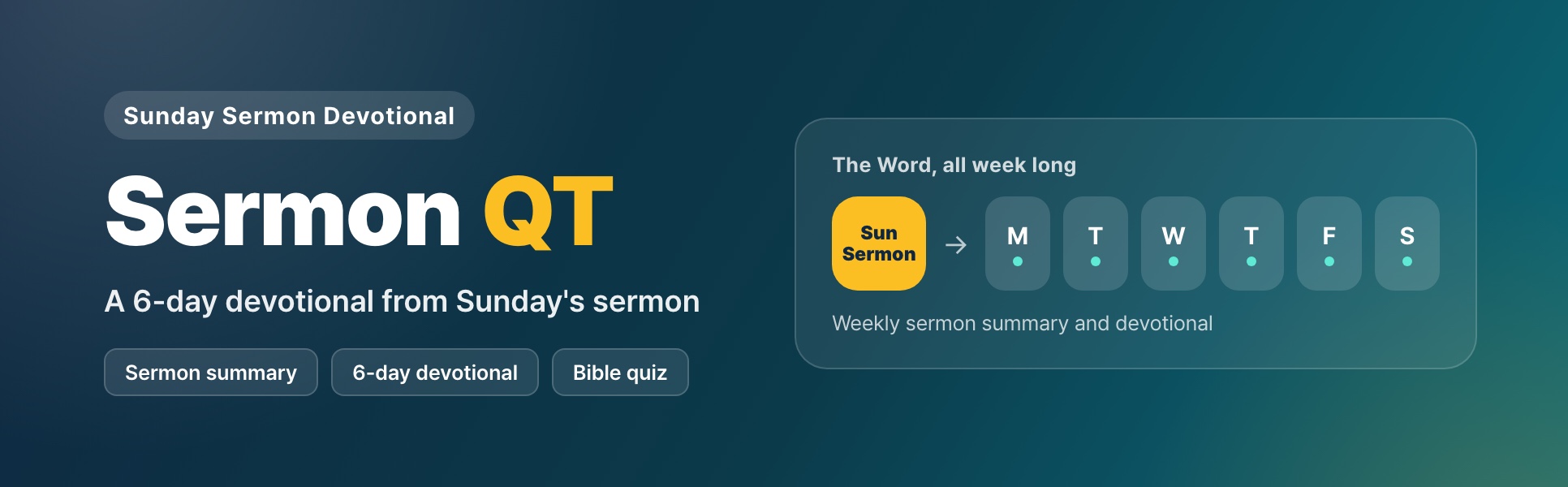
Six days of devotions drawn from this Sunday's sermon — one for each day, Monday through Saturday.
Five quick questions from this Sunday's message. Tap an answer to see if you're right.
-
What was the first action Jesus took after he took the bread in the miracle of the five loaves and two fish?
Jesus looked up to heaven and offered a prayer of thanks after taking the bread.
Amen. Today's message is from Mark 6:30-44. We will read Mark 6:41 together as our main text. Let's begin. "Taking the five loaves and the two fish and looking up to heaven, he gave thanks and broke the loaves. Then he gave them to his disciples to distribute to the people. He also divided the two fish among them all." Amen. Before we start, let’s greet the person next to us. "Let’s live a life of sharing." "Let’s live a life of sharing." "One more time. Let’s live a life of sharing." Yes, everyone. You will understand why I suddenly asked for this greeting as you listen to the sermon. Today, the message we are sharing is about the miracle of the five loaves and two fish. It is a passage we often hear and are familiar with. It is a message frequently addressed in church and is so important that it is recorded in all four Gospels. Today, I would like to look at this familiar passage from a slightly different perspective. We only read verse 41 today. Focusing on verse 41, we see that Jesus took the loaves, gave thanks, broke them, and gave them to his disciples to distribute to the people. I want to deeply reflect on the meaning of this series of actions. In this familiar scene that we might overlook, we can deeply examine who Jesus is and what grace he gives us. I pray that this will be a time to experience the abundant love of Jesus, who supplies everything and ultimately gave himself without reservation.
Gratitude That Begins in the Lord's Hands
First, let’s start with the scene where Jesus takes the loaves and looks up to heaven to give thanks. This scene teaches us that everything we enjoy comes from Jesus. Therefore, as believers, we must receive with gratitude. Since everything comes from Jesus, we must be thankful. Verse 41 records that Jesus took the five loaves and two fish. According to the Gospel of John, these loaves and fish were brought by a young boy. On the surface, the loaves and fish that the boy had are now in Jesus' hands. They were transferred from the boy's hands to Jesus' hands. Think about it for a moment. That young boy must have received those loaves and fish from someone. And the person who prepared the loaves and the person who prepared the fish must have received the necessary ingredients from someone as well. Now, let’s consider how a piece of bread came into our child's hands. A seed is sown in the ground. Then rain falls and sunlight shines. It grows into grain. Someone harvests it, grinds it into flour, kneads it, and bakes it into bread. The same goes for the fish. When God created the heavens and the earth, he created the seas of this earth. And he gave life within them. Someone catches the fish, prepares it, cooks it, and eventually it reaches the hands of the young boy. Therefore, if we trace everything we call "mine," we realize that it was received from someone before it became ours. However, we tend to take this process for granted as we go through life. We take rain for granted and assume that seeds sown will bear fruit. But the Bible tells us that these things are not to be taken for granted. Psalm 104 states, "He makes grass grow for the cattle, and plants for people to cultivate." Here, "He" refers to God. God makes it grow, brings food from the earth, and gives wine that gladdens human hearts and oil that makes their faces shine, and food that sustains their hearts. It is given by God. Also, Psalm 145 says, "The eyes of all look to you, and you give them their food at the proper time." Through these verses, we see that it is God who gives us food and everything we have. God is not a distant creator who made the world and left it; he still holds the world he created. For example, he makes it rain, causes food to grow from the earth, and through processes we do not understand, he feeds and clothes us. Without God's work, we can have nothing. God still holds all the natural laws that we take for granted. Thus, we live receiving God's grace. So, whose loaves and fish were those in the hands of the young boy? They were God's. Do you acknowledge this? Yes, they originally belonged to God. That is why David confesses in 1 Chronicles 29, "But who am I, and who are my people, that we should be able to give as generously as this? Everything comes from you, and we have given you only what comes from your hand." David confesses that we have received because the Lord has given, and we return it with a thankful heart. Beloved saints, we often make such confessions to God in our lives. "God, I give you my time. God, I give you my resources. God, I give you my talents and my life." We pray that he will gladly receive them. But we must think deeply. We say what we give is ours, but before it became ours, whose was it? It belonged to God. God has gladly entrusted his own to us. So how should we respond to these things? We should be thankful.
The Importance of a Life of Sharing
Now, looking at this perspective, the miracle of the five loaves and two fish can be seen a bit differently. Usually, we focus on the miracle of five loaves and two fish feeding 5,000 people, the multiplication of the loaves and fish, and the compassion of Jesus who performed the miracle. We often concentrate on these aspects. However, upon reflection, God feeds us even in our daily lives. In some ways, this is a miraculous daily occurrence that we enjoy but have become too accustomed to overlook. Is it natural that a seed falls to the ground and takes root? We think it is natural according to the laws of nature. But strictly speaking, it is not natural. God must send the rain. When I first came to Dallas, people always told me that I had to experience the hot Dallas summer. And now my summer has passed. So they asked me, "Have you experienced a hot Dallas summer where it hardly rained for two months and the temperature went over 100 degrees?" Yes, I have experienced it. But look, it hardly rained for two months. When it does not rain like this, don't we feel the preciousness of rain? What do we feel when it does not rain? Don't we realize that it is not natural for rain to fall on this land? God must open the heavens for rain to fall on this land. And it is not natural for grain to grow. But God accomplishes that. I believe that every process from human labor to the making and consumption of bread is grace given to us by God. Even in moments we do not realize, God is feeding and clothing us through various processes in our daily lives. However, the wilderness in today's text is a bit different. Usually, supply that takes a long time and many processes is accomplished immediately in the hands of Jesus. This is the important point. While we see the feeding of 5,000 as a miracle, from God's perspective, what is accomplished immediately through Jesus' hands is what he has always done over a long period. Jesus is now performing the work he has always done to feed God's people with his own hands. Therefore, when we look at this miracle, we should not simply ask how the bread was multiplied. It is not important how the bread fed so many people. What is more important is who is providing this bread now. Who is the one who took the bread from the hands of the young boy and fed the multitude? It is Jesus. Therefore, this miracle shows that Jesus, as the Creator and Sovereign, supplies what his people need and uses what he has made according to his will. He is not merely giving bread. The Jesus who gives bread is the Creator of heaven and earth. And he is still the Sovereign who rules over heaven and earth today. He is showing us that truth. That is why it is recorded that Jesus took the bread. He took the bread. In the Old Testament, it is expressed that he "took." The first thing we should consider in this verse is Jesus' sovereignty before the boy's dedication. He took what the Lord had given and brought it back into his hands to fulfill his will, and then he generously gave it back. However, looking at the text, we see that after Jesus took the bread in his hands, he did not immediately give it away. What does he do? Yes, let’s read together. "Taking the five loaves and the two fish, he looked up to heaven and gave thanks." It is recorded that he looked up to heaven and gave thanks. Here, there is something we should pay attention to. In our Korean Bible, all four Gospels express it as "gave thanks" or "blessed." It is translated as "to bless" or "to give thanks," but in the original language, the Gospel of John records it slightly differently. In the Gospel of Mark that we are reading, the word "blessed" is used. He blessed it. While using that word, the Gospel of John translates it as "gave thanks," and in English as "gave thanks," but in the original language, the act of looking up to heaven and giving thanks is specifically described with the word "to thank." The act of blessing that Jesus performed while holding the bread carries a deep meaning of praising and thanking God who gave the bread. Now, this naturally connects to what we examined earlier. For those who believe and follow God, everything comes from him, and we must receive what we have with gratitude, not taking it for granted. Jesus looked at the bread in his hands and gave thanks to God who gave it. In the wilderness, Jesus holds what God has given and gives thanks. Seeing this scene, we can naturally recall another wilderness in the Old Testament. That is Exodus 16. In Exodus 16, the people of Israel come out of Egypt by God's grace. And they enter the wilderness. However, when they arrive in the wilderness, there is nothing to eat. So when they become hungry, the people begin to complain to Moses and Aaron. Despite God rescuing them from captivity, they cannot wait and complain about the lack of food. How did they complain? The Israelites said, "If only we had died by the Lord's hand in Egypt! There we sat around pots of meat and ate all the food we wanted, but you have brought us out into this desert to starve this entire assembly to death." Wait a minute, what was their condition in Egypt? Were they not slaves? What delicious food could a slave eat? Was there bread or meat that a slave could eat to their fill? Humans seem to be creatures that easily forget. They forget the past and focus on the difficulties of the present, leading to complaints and grievances. The Israelites poured out their complaints and dissatisfaction, forgetting the grace of God's salvation that had just occurred. Yet, despite this, God did not abandon them and sent manna from heaven. In the midst of that desolate wilderness, God sent manna every day to feed them. When you think about it, isn't this an amazing event? Just the day before, it was a barren wilderness with nothing, but in the morning, that barren land was covered with abundant manna to eat. It was not just for one day or two days. God continued to feed them for 40 years while they were in the wilderness. The miracle of God became their daily life. However, we see how fickle the human heart can be. Over time, their hearts began to change. Initially, the grateful provision that fed them in the desolate wilderness became something they no longer found amazing as they saw the manna falling every day. In Numbers 11, they complain, "We have lost our appetite; we never see anything but this manna!" What do you think of their attitude? How do you feel about their complaints while witnessing the miracle of God sending manna? They became accustomed to the grace that sustained their lives, and at some point, it became merely an object of complaint. Humans seem to be truly strange beings. When we do not have something, we pray, "God, please give me that." "I will be so grateful if you give me that." "I won't ask for anything more." But when we actually receive it, we take it for granted and say, "God, this is not it." "Please give me something else." There is no gratitude for what has been given. Before getting a job, what do we do? We say, "God, if you give me a job, I will serve diligently." But once we get the job, what happens? In the morning, we wake up and say, "God, this is too hard." "Why did you give me such a difficult job?" "Why is our company so tough?" Complaining like this is the nature of our hearts. Before marriage, we pray, "Please let me meet a good spouse." I expected an "Amen" from the second floor, but no one said "Amen." Yes, anyway, before marriage, we pray to meet a good spouse, but what happens after marriage? What happens? Currently, we are running a marriage school, and you are diligently learning and getting to know each other, but what about after marriage? >> Is it good? >> Yes. I will stop here. We— you and I, no, humanity— seem to have a bad habit of taking God's grace for granted or letting it pass quickly. However, in another wilderness, the appearance of our Jesus is completely different. He holds the bread in his hands and looks up to God in heaven to give thanks. He receives what the Father has given, relies on the Father, and uses it to fulfill God's will. He begins with gratitude. Therefore, Jesus' prayer of blessing is not merely an expression of thanks; it includes deep trust, reliance, and obedience to God the Father. In a situation of lack, Jesus receives what the Father has given with gratitude, expects and trusts that the Father will provide, and obeys God's will. Beloved saints, how often do we take God's grace for granted as we live on this earth? Is it natural to open our eyes today? Is it natural to have food? Do we only realize it when we lack it? When there is no food, do we say, "Ah, that was God's grace back then"? Is it natural to have a loving family by our side? No. No matter how much the person next to you may trouble you, the fact that they are by your side is not something to be taken for granted. Being able to work, to worship, and that you are here— in some ways, nothing is natural from the beginning. I believe that everything I have is received from God. I believe that everything is God's grace. >> Amen. >> When we know that everything we have comes from the Lord we believe in, and we receive it with gratitude without taking it for granted, grace begins to govern our lives. I pray in the name of the Lord that we may always be thankful for the Lord's grace and live under God's governance. >> Amen.
Leave your email to unlock Tuesday–Saturday devotionals, the full transcript and quiz free for 4 weeks. The weekly sermon email keeps coming after that.
Already subscribed? Sign inUnsubscribe anytime from the link in each email. Already subscribed? Open the link in your email.
