Ahab sought to take Naboth's vineyard, but God made him realize that the land did not belong to him. We must remember that everything we have belongs to God.
1. After these things, Naboth the Jezreelite had a vineyard, which was in Jezreel, hard by the palace of Ahab king of Samaria. 2. Ahab spoke to Naboth, saying, “Give me your vineyard, that I may have it for a garden of herbs, beca…
Through the story of Elijah, we should reconsider the importance of God's will and mission. King Ahab abused his power to seize Naboth's vineyard, which was an evil act that disregarded the laws and principles set by God. We must remember that even within the church, our desires for power and honor can hurt one another, and true leaders should honor God as their King and live according to His will. Ultimately, let us believe that our lives and community can be renewed through the Word and strive to follow that path.
- 1 Kings 21:1-6 1. After these things, Naboth the Jezreelite had a vineyard, which was in Jezreel, hard by the palace of Ahab king of Samaria. 2. Ahab spoke to Naboth, saying, “Give me your vineyard, that I may have it for a garden of herbs, because it is near to my house; and I will give you for it a better vineyard than it. Or, if it seems good to you, I will give you its worth in money.” 3. Naboth said to Ahab, “May Yahweh forbid me, that I should give the inheritance of my fathers to you!” 4. Ahab came into his house sullen and angry because of the word which Naboth the Jezreelite had spoken to him; for he had said, “I will not give you the inheritance of my fathers.” He laid himself down on his bed, and turned away his face, and would eat no bread. 5. But Jezebel his wife came to him, and said to him, “Why is your spirit so sad, that you eat no bread?” 6. He said to her, “Because I spoke to Naboth the Jezreelite, and said to him, ‘Give me your vineyard for money; or else, if it pleases you, I will give you another vineyard for it.’ He answered, ‘I will not give you my vineyard.’”
- 1 Kings 18 1. After many days, Yahweh’s word came to Elijah, in the third year, saying, “Go, show yourself to Ahab; and I will send rain on the earth.” 2. Elijah went to show himself to Ahab. The famine was severe in Samaria. 3. Ahab called Obadiah, who was over the household. (Now Obadiah feared Yahweh greatly: 4. for it was so, when Jezebel cut off the prophets of Yahweh, that Obadiah took one hundred prophets, and hid them by fifty in a cave, and fed them with bread and water.) 5. Ahab said to Obadiah, “Go through the land, to all the springs of water, and to all the brooks. Perhaps we may find grass and save the horses and mules alive, that we not lose all the animals.” 6. So they divided the land between them to pass throughout it: Ahab went one way by himself, and Obadiah went another way by himself. 7. As Obadiah was on the way, behold, Elijah met him: and he recognized him, and fell on his face, and said, “Is it you, my lord Elijah?” 8. He answered him, “It is I. Go, tell your lord, ‘Behold, Elijah is here!’” 9. He said, “Wherein have I sinned, that you would deliver your servant into the hand of Ahab, to kill me? 10. As Yahweh your God lives, there is no nation or kingdom, where my lord has not sent to seek you. When they said, ‘He is not here,’ he took an oath of the kingdom and nation, that they didn’t find you. 11. Now you say, ‘Go, tell your lord, “Behold, Elijah is here.”’ 12. It will happen, as soon as I am gone from you, that the Spirit of Yahweh will carry you I don’t know where; and so when I come and tell Ahab, and he can’t find you, he will kill me. But I, your servant, have feared Yahweh from my youth. 13. Wasn’t it told my lord what I did when Jezebel killed the prophets of Yahweh, how I hid one hundred men of Yahweh’s prophets with fifty to a cave, and fed them with bread and water? 14. Now you say, ‘Go, tell your lord, “Behold, Elijah is here”;’ and he will kill me.” 15. Elijah said, “As Yahweh of Armies lives, before whom I stand, I will surely show myself to him today.” 16. So Obadiah went to meet Ahab, and told him; and Ahab went to meet Elijah. 17. When Ahab saw Elijah, Ahab said to him, “Is that you, you troubler of Israel?” 18. He answered, “I have not troubled Israel; but you, and your father’s house, in that you have forsaken the commandments of Yahweh, and you have followed the Baals. 19. Now therefore send, and gather to me all Israel to Mount Carmel, and four hundred fifty of the prophets of Baal, and four hundred of the prophets of the Asherah, who eat at Jezebel’s table.” 20. So Ahab sent to all the children of Israel, and gathered the prophets together to Mount Carmel. 21. Elijah came near to all the people, and said, “How long will you waver between the two sides? If Yahweh is God, follow him; but if Baal, then follow him.” The people answered him not a word. 22. Then Elijah said to the people, “I, even I only, am left a prophet of Yahweh; but Baal’s prophets are four hundred fifty men. 23. Let them therefore give us two bulls; and let them choose one bull for themselves, and cut it in pieces, and lay it on the wood, and put no fire under; and I will dress the other bull, and lay it on the wood, and put no fire under it. 24. You call on the name of your god, and I will call on Yahweh’s name. The God who answers by fire, let him be God.” All the people answered, “It is well said.” 25. Elijah said to the prophets of Baal, “Choose one bull for yourselves, and dress it first; for you are many; and call on the name of your god, but put no fire under it.” 26. They took the bull which was given them, and they dressed it, and called on the name of Baal from morning even until noon, saying, “Baal, hear us!” But there was no voice, nor any who answered. They leaped about the altar which was made. 27. At noon, Elijah mocked them, and said, “Cry aloud; for he is a god. Either he is musing, or he has gone aside, or he is on a journey, or perhaps he sleeps and must be awakened.” 28. They cried aloud, and cut themselves in their way with knives and lances, until the blood gushed out on them. 29. It was so, when midday was past, that they prophesied until the time of the offering of the offering; but there was neither voice, nor any to answer, nor any who regarded. 30. Elijah said to all the people, “Come near to me”; and all the people came near to him. He repaired the altar of Yahweh that was thrown down. 31. Elijah took twelve stones, according to the number of the tribes of the sons of Jacob, to whom Yahweh’s word came, saying, “Israel shall be your name.” 32. With the stones he built an altar in Yahweh’s name. He made a trench around the altar, large enough to contain two measures of seed. 33. He put the wood in order, and cut the bull in pieces, and laid it on the wood. He said, “Fill four jars with water, and pour it on the burnt offering, and on the wood.” 34. He said, “Do it a second time”; and they did it the second time. He said, “Do it a third time”; and they did it the third time. 35. The water ran around the altar; and he also filled the trench with water. 36. At the time of the offering of the offering, Elijah the prophet came near, and said, “Yahweh, the God of Abraham, of Isaac, and of Israel, let it be known this day that you are God in Israel, and that I am your servant, and that I have done all these things at your word. 37. Hear me, Yahweh, hear me, that this people may know that you, Yahweh, are God, and that you have turned their heart back again.” 38. Then the fire of Yahweh fell, and consumed the burnt offering, and the wood, and the stones, and the dust, and licked up the water that was in the trench. 39. When all the people saw it, they fell on their faces. They said, “Yahweh, he is God! Yahweh, he is God!” 40. Elijah said to them, “Seize the prophets of Baal! Don’t let one of them escape!” They seized them. Elijah brought them down to the brook Kishon, and killed them there. 41. Elijah said to Ahab, “Get up, eat and drink; for there is the sound of abundance of rain.” 42. So Ahab went up to eat and to drink. Elijah went up to the top of Carmel; and he bowed himself down on the earth, and put his face between his knees. 43. He said to his servant, “Go up now, look toward the sea.” He went up, and looked, and said, “There is nothing.” He said, “Go again” seven times. 44. On the seventh time, he said, “Behold, a small cloud, like a man’s hand, is rising out of the sea.” He said, “Go up, tell Ahab, ‘Get ready and go down, so that the rain doesn’t stop you.’” 45. In a little while, the sky grew black with clouds and wind, and there was a great rain. Ahab rode, and went to Jezreel. 46. The hand of Yahweh was on Elijah; and he tucked his cloak into his belt and ran before Ahab to the entrance of Jezreel.
- 1 Kings 21:9 9. She wrote in the letters, saying, “Proclaim a fast, and set Naboth on high among the people.
- 1 Kings 21:23 23. Yahweh also spoke of Jezebel, saying, “The dogs shall eat Jezebel by the rampart of Jezreel.
- Deuteronomy 28:26 26. Your dead body will be food to all birds of the sky, and to the animals of the earth; and there will be no one to frighten them away.
- 1 Kings 21:27 27. When Ahab heard those words, he tore his clothes, and put sackcloth on his flesh, and fasted, and lay in sackcloth, and went softly.
- Ezekiel 18 1. Yahweh’s word came to me again, saying, 2. What do you mean, that you use this proverb concerning the land of Israel, saying, The fathers have eaten sour grapes, and the children’s teeth are set on edge? 3. As I live, says the Lord Yahweh, you shall not use this proverb any more in Israel. 4. Behold, all souls are mine; as the soul of the father, so also the soul of the son is mine: the soul who sins, he shall die. 5. But if a man is just, and does that which is lawful and right, 6. and has not eaten on the mountains, neither has lifted up his eyes to the idols of the house of Israel, neither has defiled his neighbor’s wife, neither has come near to a woman in her impurity, 7. and has not wronged any, but has restored to the debtor his pledge, has taken nothing by robbery, has given his bread to the hungry, and has covered the naked with a garment; 8. he who has not lent on interest, neither has taken any increase, who has withdrawn his hand from iniquity, has executed true justice between man and man, 9. has walked in my statutes, and has kept my ordinances, to deal truly; he is just, he shall surely live, says the Lord Yahweh. 10. If he fathers a son who is a robber who sheds blood, and who does any one of these things, 11. or who does not do any of those things, but even has eaten on the mountains, and defiled his neighbor’s wife, 12. has wronged the poor and needy, has taken by robbery, has not restored the pledge, and has lifted up his eyes to the idols, has committed abomination, 13. has lent on interest, and has taken increase; shall he then live? he shall not live: he has done all these abominations; he shall surely die; his blood shall be on him. 14. Now, behold, if he fathers a son, who sees all his father’s sins, which he has done, and fears, and does not such like; 15. who has not eaten on the mountains, neither has lifted up his eyes to the idols of the house of Israel, has not defiled his neighbor’s wife, 16. neither has wronged any, has not taken anything to pledge, neither has taken by robbery, but has given his bread to the hungry, and has covered the naked with a garment; 17. who has withdrawn his hand from the poor, who has not received interest nor increase, has executed my ordinances, has walked in my statutes; he shall not die for the iniquity of his father, he shall surely live. 18. As for his father, because he cruelly oppressed, robbed his brother, and did that which is not good among his people, behold, he shall die in his iniquity. 19. Yet you say, Why doesn’t the son bear the iniquity of the father? When the son has done that which is lawful and right, and has kept all my statutes, and has done them, he shall surely live. 20. The soul who sins, he shall die: the son shall not bear the iniquity of the father, neither shall the father bear the iniquity of the son; the righteousness of the righteous shall be on him, and the wickedness of the wicked shall be on him. 21. But if the wicked turn from all his sins that he has committed, and keep all my statutes, and do that which is lawful and right, he shall surely live, he shall not die. 22. None of his transgressions that he has committed shall be remembered against him: in his righteousness that he has done he shall live. 23. Have I any pleasure in the death of the wicked? says the Lord Yahweh; and not rather that he should return from his way, and live? 24. But when the righteous turns away from his righteousness, and commits iniquity, and does according to all the abominations that the wicked man does, shall he live? None of his righteous deeds that he has done shall be remembered: in his trespass that he has trespassed, and in his sin that he has sinned, in them shall he die. 25. Yet you say, The way of the Lord is not equal. Hear now, house of Israel: Is my way not equal? Aren’t your ways unequal? 26. When the righteous man turns away from his righteousness, and commits iniquity, and dies therein; in his iniquity that he has done shall he die. 27. Again, when the wicked man turns away from his wickedness that he has committed, and does that which is lawful and right, he shall save his soul alive. 28. Because he considers, and turns away from all his transgressions that he has committed, he shall surely live, he shall not die. 29. Yet the house of Israel says, “The way of the Lord is not fair.” House of Israel, aren’t my ways fair? Aren’t your ways unfair? 30. Therefore I will judge you, house of Israel, everyone according to his ways, says the Lord Yahweh. Return, and turn yourselves from all your transgressions; so iniquity shall not be your ruin. 31. Cast away from you all your transgressions, in which you have transgressed; and make yourself a new heart and a new spirit: for why will you die, house of Israel? 32. For I have no pleasure in the death of him who dies, says the Lord Yahweh: therefore turn yourselves, and live.
- 1 Kings 19 1. Ahab told Jezebel all that Elijah had done, and how he had killed all the prophets with the sword. 2. Then Jezebel sent a messenger to Elijah, saying, “So let the gods do to me, and more also, if I don’t make your life as the life of one of them by tomorrow about this time!” 3. When he saw that, he arose, and went for his life, and came to Beersheba, which belongs to Judah, and left his servant there. 4. But he himself went a day’s journey into the wilderness, and came and sat down under a juniper tree: and he requested for himself that he might die, and said, “It is enough. Now, O Yahweh, take away my life; for I am not better than my fathers.” 5. He lay down and slept under a juniper tree; and behold, an angel touched him, and said to him, “Arise and eat!” 6. He looked, and behold, there was at his head a cake baked on the coals, and a jar of water. He ate and drank, and lay down again. 7. Yahweh’s angel came again the second time, and touched him, and said, “Arise and eat, because the journey is too great for you.” 8. He arose, and ate and drank, and went in the strength of that food forty days and forty nights to Horeb the Mount of God. 9. He came there to a cave, and lodged there; and behold, Yahweh’s word came to him, and he said to him, “What are you doing here, Elijah?” 10. He said, “I have been very jealous for Yahweh, the God of Armies; for the children of Israel have forsaken your covenant, thrown down your altars, and slain your prophets with the sword. I, even I only, am left; and they seek my life, to take it away.” 11. He said, “Go out, and stand on the mountain before Yahweh.” Behold, Yahweh passed by, and a great and strong wind tore the mountains, and broke in pieces the rocks before Yahweh; but Yahweh was not in the wind. After the wind an earthquake; but Yahweh was not in the earthquake. 12. After the earthquake a fire passed; but Yahweh was not in the fire: and after the fire a still small voice. 13. It was so, when Elijah heard it, that he wrapped his face in his mantle, and went out, and stood in the entrance of the cave. Behold, a voice came to him, and said, “What are you doing here, Elijah?” 14. He said, “I have been very jealous for Yahweh, the God of Armies; for the children of Israel have forsaken your covenant, thrown down your altars, and slain your prophets with the sword. I, even I only, am left; and they seek my life, to take it away.” 15. Yahweh said to him, “Go, return on your way to the wilderness of Damascus. When you arrive, you shall anoint Hazael to be king over Syria. 16. You shall anoint Jehu the son of Nimshi to be king over Israel; and you shall anoint Elisha the son of Shaphat of Abel Meholah to be prophet in your place. 17. It shall happen, that he who escapes from the sword of Hazael, Jehu will kill; and he who escapes from the sword of Jehu, Elisha will kill. 18. Yet will I leave seven thousand in Israel, all the knees which have not bowed to Baal, and every mouth which has not kissed him.” 19. So he departed there, and found Elisha the son of Shaphat, who was plowing, with twelve yoke of oxen before him, and he with the twelfth: and Elijah passed over to him, and cast his mantle on him. 20. He left the oxen, and ran after Elijah, and said, “Let me please kiss my father and my mother, and then I will follow you.” He said to him, “Go back again; for what have I done to you?” 21. He returned from following him, and took the yoke of oxen, and killed them, and boiled their flesh with the instruments of the oxen, and gave to the people, and they ate. Then he arose, and went after Elijah, and served him.
Repentance before God is the beginning of true change
- Restoration of Elijah's Mission
- Ahab's Evil Deeds and Repentance
- The Evil Deeds of Jezebel
- God's Covenant and Curse
- The Importance of Repentance
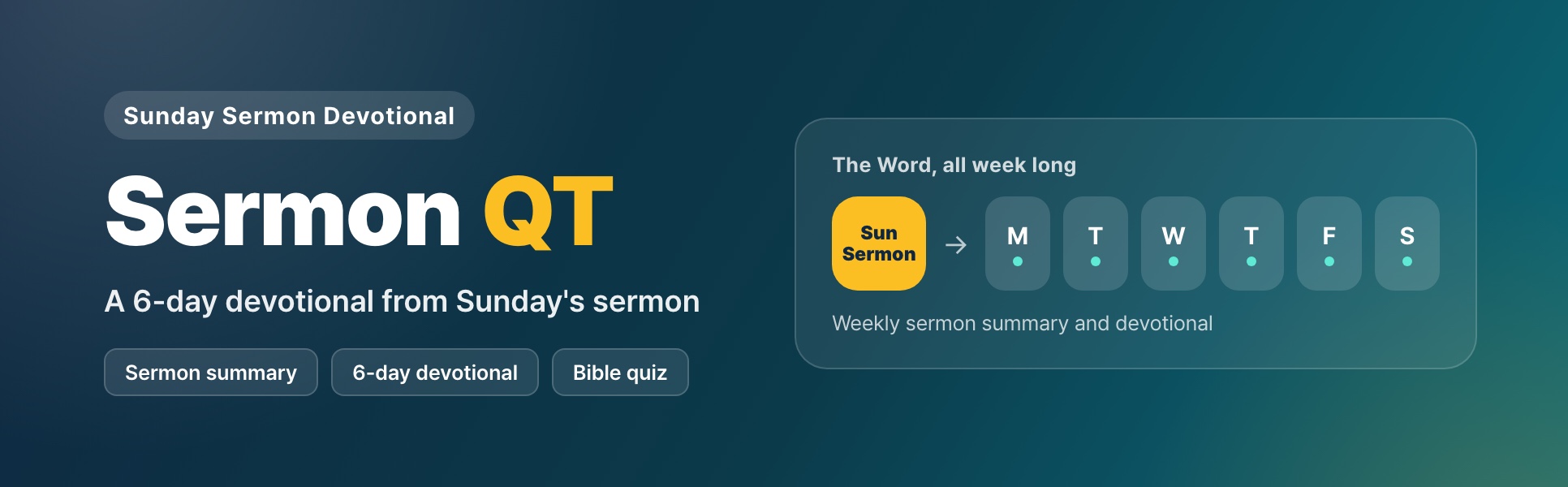
Six days of devotions drawn from this Sunday's sermon — one for each day, Monday through Saturday.
Five quick questions from this Sunday's message. Tap an answer to see if you're right.
-
Why did Elijah warn Ahab?
Elijah delivered God's message to warn Ahab about his wicked act of trying to seize Naboth's vineyard.
Amen. Right now, we are talking about Elijah. Elijah did an incredible thing in 1 Kings 18. This led to the spiritual battle between Ahab and Elijah known as the battle of Mount Carmel, where Elijah defeated the prophets of Baal and Asherah who had been causing trouble. When Elijah prayed and the people prayed, fire came down from heaven. A tremendous miracle occurred with fire coming down and heavy rain falling after a long drought. You see, the sudden downpour of fire and the pouring out of water are events that cannot happen without miraculous divine intervention. So, based on this chapter 18, we thought that from now on, the era of Elijah would come, and Ahab would be completely defeated and fall apart. However, strangely enough, Ahab continues to prosper. He wins battles and what happens to Elijah? He becomes despondent, saying, "I can't do this anymore. I might as well be dead. I can't be a prophet." In this situation, Ahab is doing so well that he looks at the vineyard next to his palace and thinks, "I need to take that." He goes to Naboth's vineyard and says, "Give it to me. Sell it to me. Transfer it at a good price. You can go somewhere else. I will take care of this." He speaks so carelessly.
Everyone, this is how wicked it is: God has declared that the land belongs to Him, and since the land belongs to God, it is unacceptable to buy and sell it as if it were a commodity. The term "passing on the inheritance" means that I have received land that was originally distributed to each tribe from my ancestors, but if I cannot possess this land and someone else cultivates it, and I have to pay off debts through it, then after a few years, if a prominent person from that family returns it, it is meant to go back to the original owner. There is no law that allows someone to completely transfer ownership to someone else. This is to prevent polarization, to ensure that the poorest and oppressed minorities do not continue to live in hardship. God has made it so that the most vulnerable can regain their original possessions if they are given a little time. Thus, God has established mechanisms to prevent polarization among His people. The principle of averages is to be realized. Therefore, God has set up provisions for the weak among His people, for orphans and widows, and the king, as a representative, should protect the rights and properties of the people. However, when the king himself tries to take it away, it shows how wicked Ahab is. Other kings of other nations may take what they want, but one thing that a king in God's kingdom must never do is this. Thus, Ahab's extreme wickedness is exemplified by his attempt to seize Naboth's vineyard.
In this context, Ahab's attitude appears in verse 4 of chapter 21, where Naboth tells Ahab, "I cannot sell that to you. No matter how much money you offer, I cannot give you the inheritance received from my ancestors." He is a man of God. At that moment, Ahab should have realized, "Ah, that's right. It is God's land. It cannot be mine. I am the king of Israel. I should not wield my power carelessly like the kings of other nations." He should have said, "I'm sorry. I made a mistake." But suddenly, he becomes upset and displeased, saying, "What do you mean?" He is distressed and troubled. Can it be that I, the king, am not being listened to? He becomes angry and distressed and returns to the palace without eating, lying down. Everyone, we should underline Ahab's distress and trouble in this verse. Because in chapter 21, Ahab's psychological state regarding Naboth's vineyard is one of distress and trouble. The author's intention is that the same thing is mentioned in chapter 20. If you look at verse 42 and onward, it says that he asked the king, "The word of the Lord is that since you have let go of the man I had determined to destroy, your life will be exchanged for his, and your people for his people." What this means is that after fighting a war with Ben-Hadad, the king of Aram, the Aramean enemy came to the king asking for mercy, and he said, "Alright, I will spare you." He thought, "He is my brother. Since he apologized to me, I will show him mercy and spare him." He let the opposing king's life go. The Lord's word was, "Since you have let go of the man I had determined to destroy." So, in verse 43, it says that the king of Israel was distressed and troubled. Why was he distressed and troubled? Because he had done something wrong, and God would punish him. He heard that God would not let him go unpunished. Thus, Ahab returned to the palace distressed and troubled.
Leave your email to unlock Tuesday–Saturday devotionals, the full transcript and quiz free for 4 weeks. The weekly sermon email keeps coming after that.
Already subscribed? Sign inUnsubscribe anytime from the link in each email. Already subscribed? Open the link in your email.
